Advertisements
Advertisements
Question
In the adjoining figure, name the following pairs of angles.
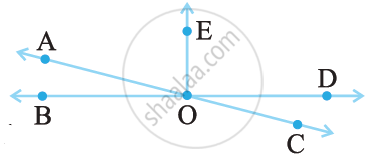
- Obtuse vertically opposite angles
- Adjacent complementary angles
- Equal supplementary angles
- Unequal supplementary angles
- Adjacent angles that do not form a linear pair
Sum
Advertisements
Solution
- ∠AOD, ∠BOC
- ∠EOA, ∠AOB
- ∠EOB, ∠EOD
- ∠EOA, ∠EOC
- ∠AOB and ∠AOE; ∠AOE and ∠EOD; ∠EOD and ∠COD
shaalaa.com
Is there an error in this question or solution?
RELATED QUESTIONS
Draw the pairs of angles as described below. If that is not possible, say why.
Adjacent angles which are not in a linear pair.
In the given figure, Identify three linear pairs.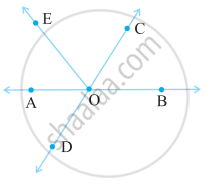
In the given figure the angles ∠1 and ∠2 are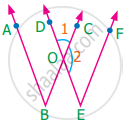
In the given figure, find the value of x
Find the value of x, y and z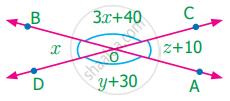
In the following figure, PQ is a mirror, AB is the incident ray and BC is the reflected ray. If ∠ABC = 46°, then ∠ABP is equal to ______.

The angle which makes a linear pair with an angle of 61° is of ______.
Two angles making a linear pair are always supplementary.
In the following figure, write, if any, (i) each pair of vertically opposite angles, and (ii) each linear pair.

Two angles are making a linear pair. If one of them is one-third of the other, find the angles.
