Advertisements
Advertisements
प्रश्न
In the adjoining figure, name the following pairs of angles.
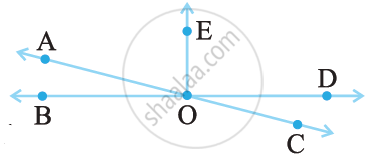
- Obtuse vertically opposite angles
- Adjacent complementary angles
- Equal supplementary angles
- Unequal supplementary angles
- Adjacent angles that do not form a linear pair
Advertisements
उत्तर
- ∠AOD, ∠BOC
- ∠EOA, ∠AOB
- ∠EOB, ∠EOD
- ∠EOA, ∠EOC
- ∠AOB and ∠AOE; ∠AOE and ∠EOD; ∠EOD and ∠COD
संबंधित प्रश्न
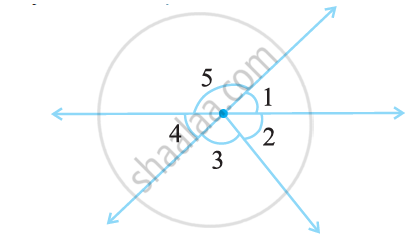
Indicate which pairs of angles are: Linear pairs.
Given that AB is a straight line. Calculate the value of x° in the following cases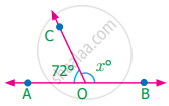
In the given figure, find the value of x
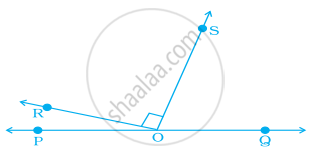
In the following figure, ∠ROS is a right angle and ∠POR and ∠QOS are in the ratio 1 : 5. Then, ∠QOS measures ______.
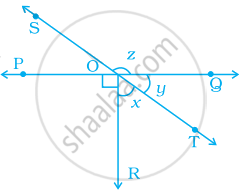
In the following figure, lines PQ and ST intersect at O. If ∠POR = 90° and x : y = 3 : 2, then z is equal to ______.
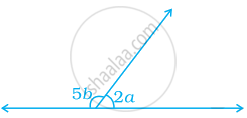
In the following figure, a = 40°. The value of b is ______.
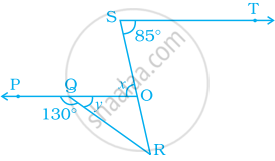
In the following figure, PQ || ST. Then, the value of x + y is ______.
In the following figure, write, if any, (i) each pair of vertically opposite angles, and (ii) each linear pair.

What is the type of other angle of a linear pair if one of its angles is right?
