Advertisements
Advertisements
प्रश्न
In the adjoining figure, name the following pairs of angles.
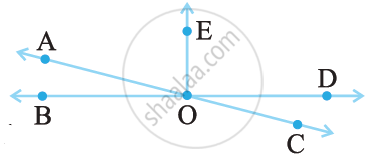
- Obtuse vertically opposite angles
- Adjacent complementary angles
- Equal supplementary angles
- Unequal supplementary angles
- Adjacent angles that do not form a linear pair
Advertisements
उत्तर
- ∠AOD, ∠BOC
- ∠EOA, ∠AOB
- ∠EOB, ∠EOD
- ∠EOA, ∠EOC
- ∠AOB and ∠AOE; ∠AOE and ∠EOD; ∠EOD and ∠COD
संबंधित प्रश्न
Indicate which pairs of angles are: Linear pairs.
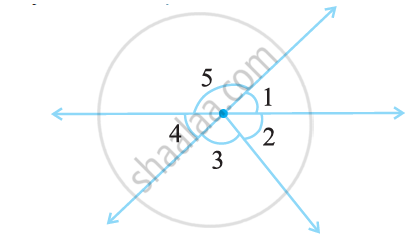
Given that AB is a straight line. Calculate the value of x° in the following cases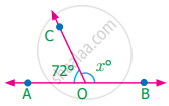
If the three angles at a point are in the ratio 1 : 4 : 7, find the value of each angle?
There are six angles at a point. One of them is 45° and the other five angles are all equal. What is the measure of all the five angles?
Find the value of x, y and z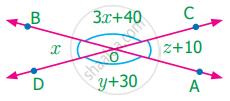
The angle which makes a linear pair with an angle of 61° is of ______.
A linear pair may have two acute angles.
In the following figure, write, if any, (i) each pair of vertically opposite angles, and (ii) each linear pair.

In the following figure, write, if any, (i) each pair of vertically opposite angles, and (ii) each linear pair.

What is the type of other angle of a linear pair if one of its angle is acute?
