Advertisements
Advertisements
Question
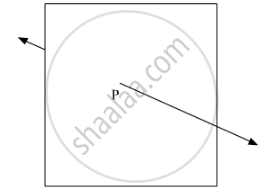
In how many points a line, not in a plane, can intersect the plane?
Advertisements
Solution
A line which is not present in the plane can intersect the plane at only one single point.
APPEARS IN
RELATED QUESTIONS
If a point C lies between two points A and B such that AC = BC, then prove that AC = `1/2` AB. Explain by drawing the figure.
In the following figure, if AC = BD, then prove that AB = CD.

In how many points two distinct lines can intersect?
The number of dimensions, a solid has ______.
Euclid divided his famous treatise “The Elements” into ______.
Solve the following question using appropriate Euclid’s axiom:
Two salesmen make equal sales during the month of August. In September, each salesman doubles his sale of the month of August. Compare their sales in September.
Solve the following question using appropriate Euclid’s axiom:
In the following figure, we have AB = BC, BX = BY. Show that AX = CY.

Solve the following question using appropriate Euclid’s axiom:
In the following figure, we have ∠1 = ∠2, ∠2 = ∠3. Show that ∠1 = ∠3.

Read the following two statements which are taken as axioms:
- If two lines intersect each other, then the vertically opposite angles are not equal.
- If a ray stands on a line, then the sum of two adjacent angles so formed is equal to 180°.
Is this system of axioms consistent? Justify your answer.
The following statement is true or false? Give reason for your answer.
There are an infinite number of lines which pass through two distinct points.
