Advertisements
Advertisements
प्रश्न
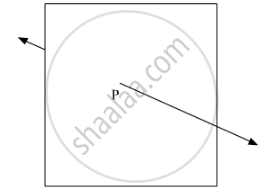
In how many points a line, not in a plane, can intersect the plane?
Advertisements
उत्तर
A line which is not present in the plane can intersect the plane at only one single point.
APPEARS IN
संबंधित प्रश्न
Give a definition of the following term. Are there other terms that need to be defined first? What are they, and how might you define them?
square
In the following figure, if AC = BD, then prove that AB = CD.

In how many lines two distinct planes can intersect?
The three steps from solids to points are ______.
The number of dimensions, a solid has ______.
The side faces of a pyramid are ______.
The number of interwoven isosceles triangles in Sriyantra (in the Atharvaveda) is ______.
The following statement is true or false? Give reason for your answer.
There are an infinite number of lines which pass through two distinct points.
The following statement is true or false? Give reason for your answer.
A terminated line can be produced indefinitely on both the sides.
The following statement is true or false? Give reason for your answer.
In the following figure, if AB = PQ and PQ = XY, then AB = XY.

