Advertisements
Advertisements
Question
Give a definition of the following term. Are there other terms that need to be defined first? What are they, and how might you define them?
square
Advertisements
Solution
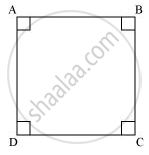
A square is a quadrilateral having all sides of equal length and all angles of the same measure, i.e.,90°. We must know about quadrilateral, side, and angle to define a square.
APPEARS IN
RELATED QUESTIONS
The following statement is true or false? Give reason for your answer.
Only one line can pass through a single point.
Give a definition of the following term. Are there other terms that need to be defined first? What are they, and how might you define them?
line segment
Consider two ‘postulates’ given below:-
- Given any two distinct points A and B, there exists a third point C which is in between A and B.
- There exist at least three points that are not on the same line.
Do these postulates contain any undefined terms? Are these postulates consistent? Do they follow from Euclid’s postulates? Explain.
The number of dimensions, a surface has ______.
Euclid belongs to the country ______.
‘Lines are parallel, if they do not intersect’ is stated in the form of ______.
“For every line l and for every point P not lying on a given line l, there exists a unique line m passing through P and parallel to l ” is known as Playfair’s axiom.
Solve the following question using appropriate Euclid’s axiom:
Two salesmen make equal sales during the month of August. In September, each salesman doubles his sale of the month of August. Compare their sales in September.
Solve the following question using appropriate Euclid’s axiom:
In the following figure, we have ∠1 = ∠3 and ∠2 = ∠4. Show that ∠A = ∠C.

The following statement is true or false? Give reason for your answer.
There are an infinite number of lines which pass through two distinct points.
