Advertisements
Advertisements
प्रश्न
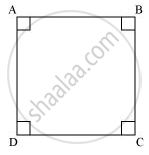
Give a definition of the following term. Are there other terms that need to be defined first? What are they, and how might you define them?
square
Advertisements
उत्तर
A square is a quadrilateral having all sides of equal length and all angles of the same measure, i.e.,90°. We must know about quadrilateral, side, and angle to define a square.
APPEARS IN
संबंधित प्रश्न
Give a definition of the following term. Are there other terms that need to be defined first? What are they, and how might you define them?
perpendicular lines
How many least number of distinct points determine a unique plane?
The number of interwoven isosceles triangles in Sriyantra (in the Atharvaveda) is ______.
The edges of a surface are curves.
The things which are double of the same thing are equal to one another.
Attempts to prove Euclid’s fifth postulate using the other postulates and axioms led to the discovery of several other geometries.
Solve the following question using appropriate Euclid’s axiom:
Look at the figure. Show that length AH > sum of lengths of AB + BC + CD.

Solve the following question using appropriate Euclid’s axiom:
In the following figure, we have AB = BC, BX = BY. Show that AX = CY.

Solve the following question using appropriate Euclid’s axiom:
In the following figure, we have X and Y are the mid-points of AC and BC and AX = CY. Show that AC = BC.

The following statement is true or false? Give reason for your answer.
In the following figure, if AB = PQ and PQ = XY, then AB = XY.

