Advertisements
Advertisements
Question
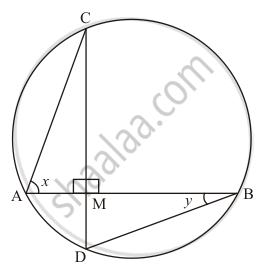
In the given figure, if chords AB and CD of the circle intersect each other at right angles, then x + y =
Options
45°
60°
75°
90°
Advertisements
Solution
90°
We are given the following figure

∠ACD = ∠ABD (Angle in the same segment are equal)
⇒ ∠ACD = y
Consider the ΔACM in which
`angleACM + x + 90° = 180°`
` y + x + 90° = 180°`
`x + y = 90°`
APPEARS IN
RELATED QUESTIONS
Write True or False. Give reasons for your answers.
A chord of a circle, which is twice as long as its radius, is a diameter of the circle.
Write True or False. Give reason for your answer.
A circle is a plane figure.
In the fig. ABC is right triangle right angled at B such that BC = 6cm and AB = 8cm. Find the radius of its in circle.
If the area of a circle is equal to sum of the areas of two circles of diameters 10 cm and 24 cm, then the diameter of the larger circle (in cm) is:
The perimeter (in cm) of a square circumscribing a circle of radius a cm, is
In a cyclic quadrilateral ABCD, if m ∠A = 3 (m ∠C). Find m ∠A.
Two circles of radii 5 cm and 3 cm intersect at two points and the distance between their centres is 4 cm. Find the length of the common chord
A circle of radius 3 cm can be drawn through two points A, B such that AB = 6 cm.
Assertion (A): If the circumference of a circle is 176 cm, then its radius is 28 cm.
Reason (R): Circumference = 2π × radius of a circle.
What is the name for the perimeter of a circle?
