Advertisements
Advertisements
Question
In a cyclic quadrilateral ABCD, if m ∠A = 3 (m ∠C). Find m ∠A.
Advertisements
Solution
It is given that
ABCD is cyclic quadrilateral and ` m angle A = 3 (m angle C ) `
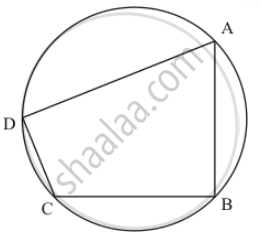
We have to find `m angle A `
Since ABCD is cyclic quadrilateral and sum of opposite pair of cyclic quadrilateral is 180°.
So ` angle A + angle C = 180°`
And
`3angleC + angleC = 180°`
`4angleC = 180°`
`angleC = (180°)/4`
= 45°
Therefore
`angleA = 3 xx 45° `
= 135°
Hence `angle A = 135°`
APPEARS IN
RELATED QUESTIONS
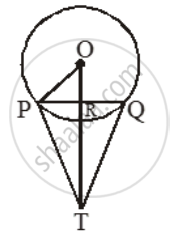
In the given figure, PQ is a chord of length 8cm of a circle of radius 5cm. The tangents at P and Q intersect at a point T. Find the length TP
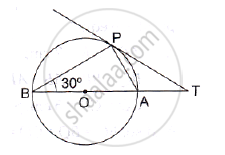
In the given figure, O is the centre of the circle and TP is the tangent to the circle from an external point T. If ∠ PBT = 30°, prove that BA : AT = 2 : 1.
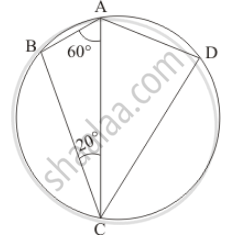
In the given figure, if ∠BAC = 60° and ∠BCA = 20°, find ∠ADC.
ABC is a right triangle in which ∠B = 90°. If AB = 8 cm and BC = 6 cm, find the diameter of the circle inscribed in the triangle.
The diameter of the circle is 52 cm and the length of one of its chord is 20 cm. Find the distance of the chord from the centre
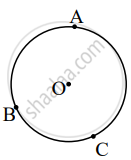
A, B, C are any points on the circle with centre O. If m(arc BC) = 110° and m(arc AB) = 125°, find measure arc AC.
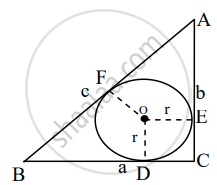
Given: A circle inscribed in a right angled ΔABC. If ∠ACB = 90° and the radius of the circle is r.
To prove: 2r = a + b – c
If d1, d2 (d2 > d1) be the diameters of two concentric circles and c be the length of a chord of a circle which is tangent to the other circle, then ______
In the following figure, O is the centre of the circle. Shade the smaller segment of the circle formed by CP.

From the figure, identify a diameter.

