Advertisements
Advertisements
Question
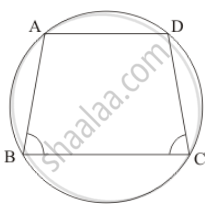
If ABCD is a cyclic quadrilateral in which AD || BC (In the given figure). Prove that ∠B = ∠C.
Advertisements
Solution
It is given that, ABCD is cyclic quadrilateral in which AD || BC
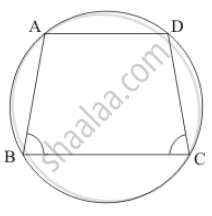
We have to prove `angleB = angle C`
Since, ABCD is a cyclic quadrilateral
So,
`angle B + angle D = 180°` and `angle A + angle C = 180°` ..… (1)
`⇒ angleB + angle A ` = 180° and `angle C + angle D = 180°` (Sum of pair of consecutive interior angles is 180°) …… (2)
From equation (1) and (2) we have
`angleB + angleD + angleB + angle A ` = 360° …… (3)
`angleA + angleC + angleC + angle D ` = 360° …… (4)
`2angleB + angleD + angleA = 2 angleC + angleA + angleD`
`2angleB = 2angleC`
`angleB = angleC`
Hence Proved
APPEARS IN
RELATED QUESTIONS
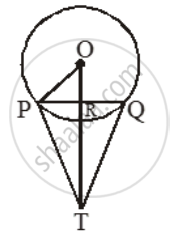
In the given figure, PQ is a chord of length 8cm of a circle of radius 5cm. The tangents at P and Q intersect at a point T. Find the length TP
In the fig two tangents AB and AC are drawn to a circle O such that ∠BAC = 120°. Prove that OA = 2AB.
In the given figure, if chords AB and CD of the circle intersect each other at right angles, then x + y =
Find the length of the chord of a circle in the following when:
Radius is 13 cm and the distance from the centre is 12 cm
Find the diameter of the circle if the length of a chord is 3.2 cm and itd distance from the centre is 1.2 cm.
All the radii of a circle are _______________
Twice the radius is ________________
Find the diameter of the circle
Radius = 10 cm
A point A is 26 cm away from the centre of a circle and the length of the tangent drawn from A to the circle is 24 cm. Find the radius of the circle.

The length of the tangent from point A to a circle, of radius 3 cm, is 4 cm. The distance of A from the centre of the circle is ______
