Advertisements
Advertisements
Question
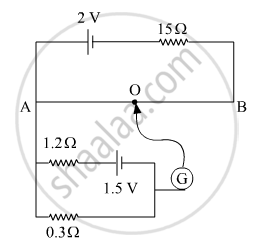
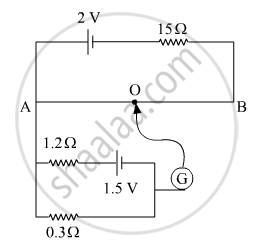
In the following potentiometer circuit, AB is a uniform wire of length 1 m and resistance 10 Ω. Calculate the potential gradient along the wire and balance length AO (= l).
Advertisements
Solution
Potential space gradient = `V_(AB)/I`
Using Kirchhoff’s rules,
`2=Ixx15+Ixx10=Ixx25=>I=2/25=0.08 A=>V_(AB)=Ixx10=0.8 =V`
`therefore " Potential space gradient "=(0.8/1)=0.8V/m`
Balance length = l
Potential difference across the balance length = Potential gradient × l
Potential difference across AO = 0.3 × 1 = 0.3 V
`therefore 0.3 V="Potential space gradient" xxI=>0.3=0.8xxI=>I=0.375 m=37.5`
RELATED QUESTIONS
Why is potentiometer preferred over a voltmeter for comparison of emf. of cells?
Identify the correct options.
(a) An ammeter should have small resistance.
(b) An ammeter should have large resistance.
(c) A voltmeter should have small resistance.
(d) A voltmeter should have large resistance.
Find the potential difference Va – Vb in the circuits shown in the figure.


A voltmeter consists of a 25 Ω coil connected in series with a 575 Ω resistor. The coil takes 10 mA for full-scale deflection. What maximum potential difference can be measured by this voltmeter?
A 6-volt battery of negligible internal resistance is connected across a uniform wire AB of length 100 cm. The positive terminal of another battery of emf 4 V and internal resistance 1 Ω is joined to the point A, as shown in the figure. Take the potential at B to be zero. (a) What are the potentials at the points A and C? (b) At which point D of the wire AB, the potential is equal to the potential at C? (c) If the points C and D are connected by a wire, what will be the current through it? (d) If the 4 V battery is replaced by a 7.5 V battery, what would be the answers of parts (a) and (b)?

A copper strip AB and an iron strip AC are joined at A. The junction A is maintained at 0°C and the free ends B and C are maintained at 100°C. There is a potential difference between _______________ .
(a) the two ends of the copper strip
(b) the copper end and the iron end at the junction
(c) the two ends of the iron strip
(d) the free ends B and C
