Advertisements
Advertisements
प्रश्न
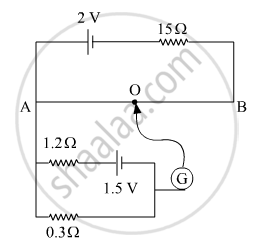
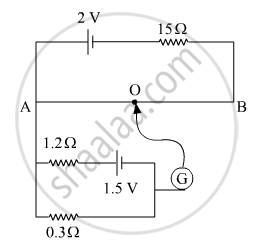
In the following potentiometer circuit, AB is a uniform wire of length 1 m and resistance 10 Ω. Calculate the potential gradient along the wire and balance length AO (= l).
Advertisements
उत्तर
Potential space gradient = `V_(AB)/I`
Using Kirchhoff’s rules,
`2=Ixx15+Ixx10=Ixx25=>I=2/25=0.08 A=>V_(AB)=Ixx10=0.8 =V`
`therefore " Potential space gradient "=(0.8/1)=0.8V/m`
Balance length = l
Potential difference across the balance length = Potential gradient × l
Potential difference across AO = 0.3 × 1 = 0.3 V
`therefore 0.3 V="Potential space gradient" xxI=>0.3=0.8xxI=>I=0.375 m=37.5`
संबंधित प्रश्न
When 5 V potential difference is applied across a wire of length 0.1 m, the drift speed of electrons is 2.5 x 10⁻⁴ m/s. If the electron density in the wire is 8 x 1028 m-3, calculate the resistivity of the material of the wire.
Describe the working principle of a solar cell. Mention three basic processes involved in the generation of emf.
Why is potentiometer preferred over a voltmeter for comparison of emf. of cells?
The emf of a cell is always greater than its terminal voltage. Why? Give reason.
A voltmeter consists of a 25 Ω coil connected in series with a 575 Ω resistor. The coil takes 10 mA for full-scale deflection. What maximum potential difference can be measured by this voltmeter?
The potential difference across the terminals of a battery of emf 12 V and internal resistance 2 Ω drops to 10 V when it is connected to a silver voltameter. Find the silver deposited at the cathode in half an hour. Atomic weight of silver is 107.9 g mol−1.
In the circuit in figure the potential difference across P and Q will be nearest to

