Advertisements
Advertisements
प्रश्न
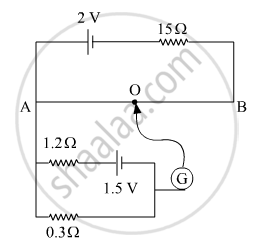
In the following potentiometer circuit, AB is a uniform wire of length 1 m and resistance 10 Ω. Calculate the potential gradient along the wire and balance length AO (= l).
Advertisements
उत्तर
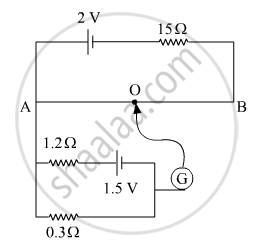
Potential space gradient = `V_(AB)/I`
Using Kirchhoff’s rules,
`2=Ixx15+Ixx10=Ixx25=>I=2/25=0.08 A=>V_(AB)=Ixx10=0.8 =V`
`therefore " Potential space gradient "=(0.8/1)=0.8V/m`
Balance length = l
Potential difference across the balance length = Potential gradient × l
Potential difference across AO = 0.3 × 1 = 0.3 V
`therefore 0.3 V="Potential space gradient" xxI=>0.3=0.8xxI=>I=0.375 m=37.5`
संबंधित प्रश्न
Why are Si and GaAs preferred materials for solar cells?
The emf of a cell is always greater than its terminal voltage. Why? Give reason.
Identify the correct options.
(a) An ammeter should have small resistance.
(b) An ammeter should have large resistance.
(c) A voltmeter should have small resistance.
(d) A voltmeter should have large resistance.
The current in a conductor and the potential difference across its ends are measured by an ammeter and a voltmeter. The meters draw negligible currents. The ammeter is accurate but the voltmeter has a zero error (that is, it does not read zero when no potential difference is applied). Calculate the zero error if the readings for two different conditions are 1.75 A, 14.4 V and 2.75 A, 22.4 V.
Find the potential difference Va – Vb in the circuits shown in the figure.


A 6-volt battery of negligible internal resistance is connected across a uniform wire AB of length 100 cm. The positive terminal of another battery of emf 4 V and internal resistance 1 Ω is joined to the point A, as shown in the figure. Take the potential at B to be zero. (a) What are the potentials at the points A and C? (b) At which point D of the wire AB, the potential is equal to the potential at C? (c) If the points C and D are connected by a wire, what will be the current through it? (d) If the 4 V battery is replaced by a 7.5 V battery, what would be the answers of parts (a) and (b)?

The potential difference across the terminals of a battery of emf 12 V and internal resistance 2 Ω drops to 10 V when it is connected to a silver voltameter. Find the silver deposited at the cathode in half an hour. Atomic weight of silver is 107.9 g mol−1.
A potential difference of 220 V is maintained across 12000 Ω rheostat. Then voltmeter V has a resistance of 6000 Ω and point C is at one fourth the distance from a to b. Then the reading of voltmeter is ______.

In the circuit in figure the potential difference across P and Q will be nearest to

