Advertisements
Advertisements
Question
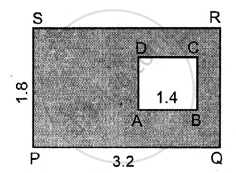
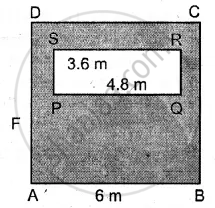
In each of the following cases, ABCD is a square and PQRS is a rectangle. Find, in each case, the area of the shaded portion.
(All measurements are in metre).
(i)
(ii)
Advertisements
Solution
(i)
Area of the shaded portion
= Area of the rectangle PQRS – Area of square ABCD
= 3.2 x 1.8 – (1.4)2 (∵ PQ = 3.2 and PS = 1.8) Side of square AB = 1.4
= 5.76 – 1.96 = 3.80 = 3.8 m2
(ii)
Area of the shaded portion = Area of square ABCD – Area of rectangle PQRS
= 6 x 6 – (3.6) (4.8) = 36 – 17.28 = 18.72 m2
APPEARS IN
RELATED QUESTIONS
The length and the breadth of a rectangular field are in the ratio 5: 4 and its area is 3380 m2. Find the cost of fencing it at the rate of ₹75 per m.
A rectangular field has length = 160m and breadth = 120 m. Find:
(i) the perimeter of the field.
(ii) the length of fence required to enclose the field.
(iii) the cost of fencing the field at the rate of? 80 per meter.
A school playground is rectangular in shape with length = 120 m and breadth = 90 m. Some school boys run along the boundary of the play-ground and make 15 complete rounds in 45 minutes. How much distance they run during this period.
Find the perimeter of a regular pentagon of side 8.2 cm.
Find the cost of fencing a rectangular park of length 250 m and breadth 175 m at the rate of Rs. 12 per metre.
If the length of a rectangle is 20 m and its width is 12 m, what is its perimeter?
Four rounds of wire fence have to be put around a field. If the field is 60 m long and 40 m wide, how much wire will be needed?
The sides of a triangle are 24.7cm, 20.4 cm, and 10.5 cm respectively. What is the perimeter of the triangle?
The length of a rectangle is three times its breadth. If its perimeter is 64 cm, find the sides of the rectangle
Length of a rectangular field is 250 m and width is 150 m. Anuradha runs around this field 3 times. How far did she run? How many times she should run around the field to cover a distance of 4 km?
