Advertisements
Advertisements
Question
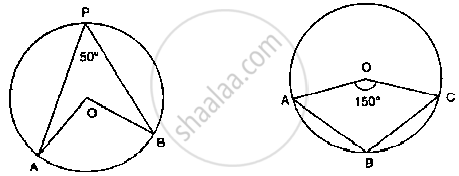
In the below fig. O is the centre of the circle. If ∠APB = 50°, find ∠AOB and ∠OAB.
Advertisements
Solution
ΔAPB = 50°
By degree measure theorem
∠AOB=2 ∠APB
⇒∠APB= 2 × 50° = 100°
Since OA =OB
[ Radius of circle ]
Then ∠OAB=∠OBA
[ Angle's opposite to equal sides ]
Let ∠OAB = x
In Δ OAB by angle sum property
`∠OAB+∠OBA+∠AOB=180°`
`⇒x+x+100=180°`
`⇒2x+100=180°`
`⇒2x=80°`
`⇒x=40°`
`∠OAB =∠OBA= 40°`
APPEARS IN
RELATED QUESTIONS
In two concentric circles, prove that all chords of the outer circle which touch the inner circle are of equal length.
true or false
The degree measure of an arc is the complement of the central angle containing the arc.
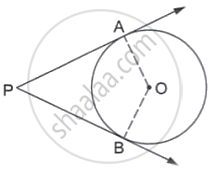
In the given figure, O is the centre of the circle. PA and PB are tangents. Show that AOBP is a cyclic quadrilateral.
Number of circles that can be drawn through three non-collinear points is
Use the figure given below to fill in the blank:
If the length of RS is 5 cm, the length of PQ = _______

A line segment which joins any two points on a circle is a ___________
Three circles touch each other externally. The distance between their centres is 5 cm, 6 cm, and 7 cm. Find the radii of the circles.
On a common hypotenuse AB, two right triangles ACB and ADB are situated on opposite sides. Prove that ∠BAC = ∠BDC.
Is every chord of a circle also a diameter?
Assertion (A): If the circumference of a circle is 176 cm, then its radius is 28 cm.
Reason (R): Circumference = 2π × radius of a circle.
