Advertisements
Advertisements
Question
In Δ ABC, if ∠C = 90°, then prove that sin (A - B) = `("a"^2 - "b"^2)/("a"^2 + "b"^2)`
Advertisements
Solution
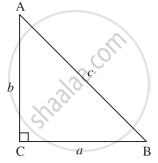
In Δ ABC, if ∠C = 90°
∴ c2 = a2 + b2 .........(1)
By sine rule,
`"a"/"sin A" = "b"/"sin B" = "c"/"sin C"`
∴ `"a"/"sin A" = "b"/"sin B" = "c"/("sin" 90°)`
∴ `"a"/"sin A" = "b"/"sin B" = "c"` .....[∵ sin 90° = 1]
∴ sin A = `"a"/"c" and "sin B" = "b"/"c"` ....(2)
LHS = sin (A - B)
= sin A cos B - cos A sin B
`= "a"/"c" cos "B" - "b"/"c" cos "A"` ....[By (2)]
`= "a"/"c" (("c"^2 + "a"^2 - "b"^2)/"2ca") - "b"/"c"(("b"^2 + "c"^2 - "a"^2)/"2bc")`
`= ("c"^2 + "a"^2 - "b"^2)/"2c"^2 - ("b"^2 + "c"^2 - "a"^2)/"2c"^2`
`= ("c"^2 + "a"^2 - "b"^2 - "b"^2 - "c"^2 + "a"^2)/"2c"^2`
`= (2"a"^2 - 2"b"^2)/"2c"^2`
`= ("a"^2 - "b"^2)/"c"^2`
`= ("a"^2 - "b"^2)/("a"^2 + "b"^2)` ...[By (1)]
= RHS.
APPEARS IN
RELATED QUESTIONS
In ΔABC, prove that `tan((A - B)/2) = (a - b)/(a + b)*cot C/2`.
In ΔABC with usual notations, prove that 2a `{sin^2(C/2)+csin^2 (A/2)}` = (a + c - b)
In any ΔABC, with usual notations, prove that b2 = c2 + a2 – 2ca cos B.
In Δ ABC, if a = 13, b = 14 and c = 15, then sin (A/2)= _______.
(A) `1/5`
(B) `sqrt(1/5)`
(C) `4/5`
(D) `2/5`
In , ΔABC prove that
`"sin"(("B" - "C")/2) = (("b" - "c")/"a") "cos"("A"/2)`
In ,Δ ABC with usual notations prove that
b2 = c2 +a2 - 2 ca cos B
Find the Cartesian coordinates of the point whose polar coordinates are :
`(4, pi/2)`
Find the Cartesian co-ordinates of the point whose polar co-ordinates are:
`(3/4, (3pi)/4)`
Solve the triangle in which a = `(sqrt3 + 1)`, b = `(sqrt3 - 1)` and ∠C = 60°.
In any Δ ABC, prove the following:
a sin A - b sin B = c sin (A - B)
In any Δ ABC, prove the following:
a2 sin (B - C) = (b2 - c2) sin A.
Show that
`tan^-1(1/5) + tan^-1(1/7) + tan^-1(1/3) + tan^-1 (1/8) = pi/4.`
Show that `(9pi)/8 - 9/4 sin^-1 (1/3) = 9/4 sin^-1 ((2sqrt2)/3)`.
Solve: `tan^-1 ("1 - x"/"1 + x") = 1/2 (tan^-1 "x")`, for x > 0.
Solve: `tan^-1 ("1 - x"/"1 + x") = 1/2 (tan^-1 "x")`, for x > 0.
In ΔABC, a = 3, b = 4 and sin A = `3/4`, find ∠B
With usual notations, prove that `(cos "A")/"a" + (cos "B")/"b" + (cos "C")/"c" = ("a"^2 + "b"^2 + "c"^2)/(2"abc")`
In ∆ABC, if a = 13, b = 14, c = 15, then find the value of cos B
In ∆ABC, prove that `(cos 2"A")/"a"^2 - (cos 2"c")/"c"^2 = 1/"a"^2 - 1/"c"^2`
In ∆ABC, if `(2cos "A")/"a" + (cos "B")/"b" + (2cos"C")/"c" = "a"/"bc" + "b"/"ca"`, then show that the triangle is a right angled
In ∆ABC, prove that `sin ((A - B)/2) = ((a - b)/c) cos C/2`
If the angles A, B, C of ΔABC are in A.P. and its sides a, b, c are in G.P., then show that a2, b2, c2 are in A.P.
In ΔABC, prove that `("b"^2 - "c"^2)/"a" cos"A" + ("c"^2 - "a"^2)/"b" cos"B" + ("a"^2 - "b"^2)/"c" cos "C"` = 0
In ∆ABC, if ∠A = `pi/2`, then prove that sin(B − C) = `("b"^2 - "c"^2)/("b"^2 + "c"^2)`
In a ΔABC, c2 sin 2B + b2 sin 2C = ?
With usual notations, if the angles A, B, C of a Δ ABC are in AP and b : c = `sqrt3 : sqrt2`.
If one side of a triangle is double the other and the angles opposite to these sides differ by 60°, then the triangle is ______
The polar co-ordinates of P are `(2, pi/6)`. If Q is the image of P about the X-axis then the polar co-ordinates of Q are ______.
In ΔABC, a = 7cm, b = 3cm and c = 8 cm, then angle A is ______
The smallest angle of the ΔABC, when a = 7, b = `4sqrt(3)` and c = `sqrt(13)` is ______.
If polar co-ordinates of a point are `(1/2, pi/2)`, then its cartesian co-ordinates are ______.
In ΔABC, if `"a" cos^2 "C"/2 + "c" cos^2 "A"/2 = (3"b")/2`, then a, b, c are in ______.
In a triangle ABC, b = `sqrt3`, c = 1 and ∠A = 30°, then the largest angle of the triangle is ______
If a = 13, b = 14, c = 15, then `cos("A"/2)` = ______.
In a ΔABC, if `("b" + "c")/11 = ("c" + "a")/12 = ("a" + "b")/13`, then cos C = ______.
Find the cartesian co-ordinates of the point whose polar co-ordinates are `(1/2, π/3)`.
If in a triangle ABC, AB = 5 units, AB = 5 units, ∠B = `cos^-1 (3/5)` and radius of circumcircle of ΔABC is 5 units, then the area (in sq.units) of ΔABC is ______.
In triangle ABC, a = 4, b = 3 and ∠A = 60°. If ' c' is a root of the equation c2 – 3c – k = 0. Then k = ______. (with usual notations)
Let ABC be a triangle such that ∠A = 45°, ∠B = 75° then `"a" + "c"sqrt(2)` is equal to ______. (in usual notation)
In a triangle ABC, in usual notation, (a + b + c)(b + c – a) = λbc will be true if ______.
If in ΔABC, `sin A/2 * sin C/2 = sin B/2` and 2s is the perimeter of the triangle, then s = ______.
The perimeter of ΔABC is 20, ∠A = 60°, area of ΔABC = `10sqrt(3)`, then find the values of a, b, c.
In ΔABC, a = 3, b = 1, cos(A – B) = `2/9`, find c.
In a triangle ABC, with usual notations, if \[\frac{2\cos\mathrm{A}}{\mathrm{a}}+\frac{\cos\mathrm{B}}{\mathrm{b}}+\frac{2\cos\mathrm{C}}{\mathrm{c}}=\frac{\mathrm{a}}{\mathrm{bc}}+\frac{\mathrm{b}}{\mathrm{ac}}\]then ∠A =
