Advertisements
Advertisements
Question
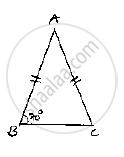
In a ΔABC, if AB = AC and ∠B = 70°, find ∠A.
Advertisements
Solution
Consider , ΔABC we have `∠B=70^@` and AB =AC
Since, AB A C ABC is an isosceles triangle
⇒ ∠B=∠C [Angles opposite to equal sides are equal]
⇒`∠B = ∠C = 70^@`
And also,
Sum of angles in a triangle `180^@`
⇒ `∠A+∠B+∠C=180^@`
⇒`∠A+70^@+70^@=180^@`
⇒`∠A+140^@=180^@`
⇒`∠A=180^@-140^@⇒∠A=40^@`
APPEARS IN
RELATED QUESTIONS
Complete the congruence statement:
ΔBCA ≅?
ΔQRS ≅?
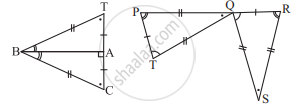
ΔPQR and ΔABC is not congruent to ΔRPQ, then which of the following is not true:
In triangles ABC and PQR three equality relations between some parts are as follows:
AB = QP, ∠B = ∠P and BC = PR
State which of the congruence conditions applies:
In ΔPQR ≅ ΔEFD then ED =
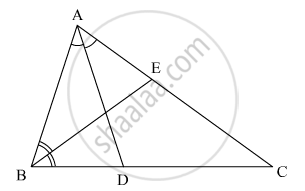
In the given figure, ABC is a triangle in which ∠B = 2∠C. D is a point on side BC such that ADbisects ∠BAC and AB = CD. BE is the bisector of ∠B. The measure of ∠BAC is
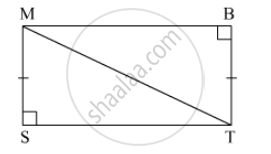
In the pair of triangles given below, the parts shown by identical marks are congruent. State the test and the one-to-one correspondence of vertices by which the triangles in the pair are congruent, the remaining congruent parts.
ΔABC is isosceles with AB = AC. BD and CE are two medians of the triangle. Prove that BD = CE.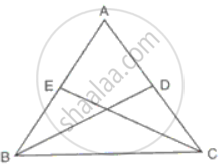
Two right-angled triangles ABC and ADC have the same base AC. If BC = DC, prove that AC bisects ∠BCD.
Given that ∆ABC ≅ ∆DEF List all the corresponding congruent angles
If AB = QR, BC = PR and CA = PQ, then ______.
