Advertisements
Advertisements
Question
In ∆ABC, AB = `6sqrt(3)` cm, AC = 12 cm, and BC = 6 cm then m∠A = ?
Options
30°
60°
90°
45°
Advertisements
Solution
30°
Explanation:
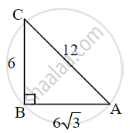
We know that, `6 = 1/2(12)`
And `6sqrt(3) = sqrt(3)/2 (12)`
∴ `BC = 1/2 AC` and `AB = sqrt(3)/2 AC`
∴ ∠A = 30° ...(Converse of 30° - 60° - 90° theorem)
APPEARS IN
RELATED QUESTIONS
In ∆PQR, PQ = √8 , QR = √5 , PR = √3. Is ∆PQR a right-angled triangle? If yes, which angle is of 90°?
In the adjacent figure, ABC is a right angled triangle with right angle at B and points D, E trisect BC. Prove that 8AE2 = 3AC2 + 5AD2

If in ∆ABC, DE || BC. AB = 3.6 cm, AC = 2.4 cm and AD = 2.1 cm then the length of AE is
8, 15, 17 is a Pythagorean triplet
The incentre is equidistant from all the vertices of a triangle
Check whether given sides are the sides of right-angled triangles, using Pythagoras theorem
8, 15, 17
Check whether given sides are the sides of right-angled triangles, using Pythagoras theorem
12, 13, 15
Check whether given sides are the sides of right-angled triangles, using Pythagoras theorem
30, 40, 50
Check whether given sides are the sides of right-angled triangles, using Pythagoras theorem
9, 40, 41
In right angled triangle, if sum of the squares of the sides of right angle is 169, then what is the length of the hypotenuse?
A rectangle having length of a side is 12 and length of diagonal is 20, then what is length of other side?
If length of both diagonals of rhombus are 60 and 80, then what is the length of side?
If a triangle having sides 50 cm, 14 cm and 48 cm, then state whether given triangle is right angled triangle or not.
If a triangle having sides 8 cm, 15 cm and 17 cm, then state whether given triangle is right angled triangle or not.
In ∆LMN, l = 5, m = 13, n = 12 then complete the activity to show that whether the given triangle is right angled triangle or not.
*(l, m, n are opposite sides of ∠L, ∠M, ∠N respectively)
Activity: In ∆LMN, l = 5, m = 13, n = `square`
∴ l2 = `square`, m2 = 169, n2 = 144.
∴ l2 + n2 = 25 + 144 = `square`
∴ `square` + l2 = m2
∴ By Converse of Pythagoras theorem, ∆LMN is right angled triangle.
In the given figure, triangle PQR is right-angled at Q. S is the mid-point of side QR. Prove that QR2 = 4(PS2 – PQ2).

In a right angled triangle, right-angled at B, lengths of sides AB and AC are 5 cm and 13 cm, respectively. What will be the length of side BC?
