Advertisements
Advertisements
Question
If in ∆ABC, DE || BC. AB = 3.6 cm, AC = 2.4 cm and AD = 2.1 cm then the length of AE is
Options
1.4 cm
1.8 cm
1.2 cm
1.05 cm
Advertisements
Solution
1.4 cm
Explanation;
Hint: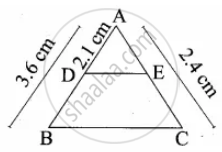
In ∆ABC and ADE
`"AB"/"AD" = "AC"/"AE" ⇒ 3.6/2.1 = 2.4/"AE"`
3.6 × AE = 2.4 × 2.1
AE = `(2.4 xx 2.1)/3.6 = (24 xx 21)/360`
AE = 1.4 cm
APPEARS IN
RELATED QUESTIONS
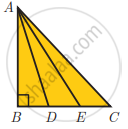
In the adjacent figure, ABC is a right angled triangle with right angle at B and points D, E trisect BC. Prove that 8AE2 = 3AC2 + 5AD2
In a ∆ABC, AD is the bisector of ∠BAC. If AB = 8 cm, BD = 6 cm and DC = 3 cm. The length of the side AC is
Two poles of heights 6 m and 11 m stand vertically on a plane ground. If the distance between their feet is 12 m, what is the distance between their tops?
If the sides of a triangle are in the ratio 5 : 12 : 13 then, it is ________
8, 15, 17 is a Pythagorean triplet
The incentre is equidistant from all the vertices of a triangle
Check whether given sides are the sides of right-angled triangles, using Pythagoras theorem
30, 40, 50
If a triangle having sides 50 cm, 14 cm and 48 cm, then state whether given triangle is right angled triangle or not.
A rectangle having dimensions 35 m × 12 m, then what is the length of its diagonal?
In ΔABC, AB = 9 cm, BC = 40 cm, AC = 41 cm. State whether ΔABC is a right-angled triangle or not. Write reason.
