Advertisements
Advertisements
Question
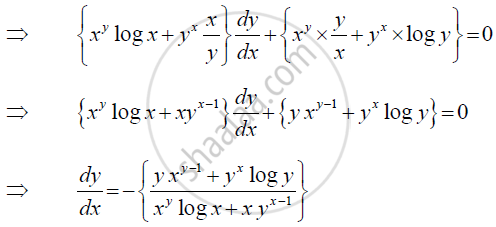
if `x^y + y^x = a^b`then Find `dy/dx`
Advertisements
Solution
Given that,
`x^y + y^x = a^b`
=> `e^(ylogx) + e^(xlogy) = a^b`
On differentiating both sides with respect to x, we get

APPEARS IN
RELATED QUESTIONS
Find `bb(dy/dx)` in the following:
xy + y2 = tan x + y
If for the function
\[\Phi \left( x \right) = \lambda x^2 + 7x - 4, \Phi'\left( 5 \right) = 97, \text { find } \lambda .\]
Find `"dy"/"dx"` ; if y = cos-1 `("2x" sqrt (1 - "x"^2))`
Differentiate e4x + 5 w.r..t.e3x
Find `(dy)/(dx) if y = cos^-1 (√x)`
Find `(dy)/(dx)` if `y = sin^-1(sqrt(1-x^2))`
If ex + ey = e(x + y), then show that `dy/dx = -e^(y - x)`.
Find `"dy"/"dx"` if x = at2, y = 2at.
Find `"dy"/"dx"` if x = a cot θ, y = b cosec θ
Find `"dy"/"dx"`, if : x = a(1 – cosθ), y = b(θ – sinθ)
Find `"dy"/"dx"`, if : x = `(t + 1/t)^a, y = a^(t+1/t)`, where a > 0, a ≠ 1, t ≠ 0.
Differentiate `sin^-1((2x)/(1 + x^2))w.r.t. cos^-1((1 - x^2)/(1 + x^2))`
If y = sin (m cos–1x), then show that `(1 - x^2)(d^2y)/(dx^2) - x"dy"/"dx" + m^2y` = 0.
Find the nth derivative of the following : (ax + b)m
Choose the correct option from the given alternatives :
Let `f(1) = 3, f'(1) = -(1)/(3), g(1) = -4 and g'(1) =-(8)/(3).` The derivative of `sqrt([f(x)]^2 + [g(x)]^2` w.r.t. x at x = 1 is
Choose the correct option from the given alternatives :
If y = sec (tan –1x), then `"dy"/"dx"` at x = 1, is equal to
If x sin (a + y) + sin a . cos (a + y) = 0, then show that `"dy"/"dx" = (sin^2(a + y))/(sina)`.
If x = `e^(x/y)`, then show that `dy/dx = (x - y)/(xlogx)`
If log y = log (sin x) – x2, show that `(d^2y)/(dx^2) + 4x "dy"/"dx" + (4x^2 + 3)y` = 0.
Find `"dy"/"dx"` if, x3 + y3 + 4x3y = 0
If y = `sqrt(tansqrt(x)`, find `("d"y)/("d"x)`.
`(dy)/(dx)` of `2x + 3y = sin x` is:-
`(dy)/(dx)` of `xy + y^2 = tan x + y` is
Find `(dy)/(dx)` if x + sin(x + y) = y – cos(x – y)
Let y = y(x) be a function of x satisfying `ysqrt(1 - x^2) = k - xsqrt(1 - y^2)` where k is a constant and `y(1/2) = -1/4`. Then `(dy)/(dx)` at x = `1/2`, is equal to ______.
If log(x+y) = log(xy) + a then show that, `dy/dx = (-y^2)/x^2`
If log(x + y) = log(xy) + a then show that, `dy/dx = (-y^2)/x^2`
Find `dy/dx` if, `x = e^(3t), y = e^(sqrtt)`
If log(x + y) = log(xy) + a then show that, `dy/dx = (-y^2)/x^2`
