Advertisements
Advertisements
प्रश्न
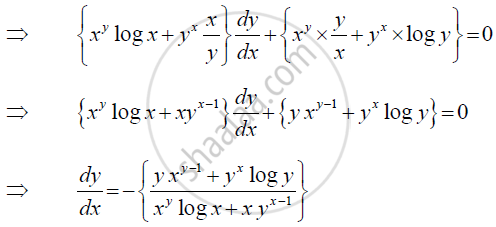
if `x^y + y^x = a^b`then Find `dy/dx`
Advertisements
उत्तर
Given that,
`x^y + y^x = a^b`
=> `e^(ylogx) + e^(xlogy) = a^b`
On differentiating both sides with respect to x, we get

APPEARS IN
संबंधित प्रश्न
If y=eax ,show that `xdy/dx=ylogy`
Find dy/dx if x sin y + y sin x = 0.
Find `bb(dy/dx)` in the following:
2x + 3y = sin y
Show that the derivative of the function f given by
Let \[f\left( x \right)\begin{cases}a x^2 + 1, & x > 1 \\ x + 1/2, & x \leq 1\end{cases}\] . Then, f (x) is derivable at x = 1, if
Find `(dy)/(dx) , "If" x^3 + y^2 + xy = 10`
Differentiate tan-1 (cot 2x) w.r.t.x.
Discuss extreme values of the function f(x) = x.logx
Find `"dy"/"dx"`, if : x = a(1 – cosθ), y = b(θ – sinθ)
Find `"dy"/"dx"`, if : `x = cos^-1(4t^3 - 3t), y = tan^-1(sqrt(1 - t^2)/t)`.
Find `"dy"/"dx"` if : x = t + 2sin (πt), y = 3t – cos (πt) at t = `(1)/(2)`
Find `(d^2y)/(dx^2)` of the following : x = sinθ, y = sin3θ at θ = `pi/(2)`
If x = at2 and y = 2at, then show that `xy(d^2y)/(dx^2) + a` = 0.
Choose the correct option from the given alternatives :
Let `f(1) = 3, f'(1) = -(1)/(3), g(1) = -4 and g'(1) =-(8)/(3).` The derivative of `sqrt([f(x)]^2 + [g(x)]^2` w.r.t. x at x = 1 is
Choose the correct option from the given alternatives :
If y = sin (2sin–1 x), then dx = ........
If x sin (a + y) + sin a . cos (a + y) = 0, then show that `"dy"/"dx" = (sin^2(a + y))/(sina)`.
Find `"dy"/"dx"` if, x3 + y3 + 4x3y = 0
Find `"dy"/"dx"` if, xy = log (xy)
If `"x"^5 * "y"^7 = ("x + y")^12` then show that, `"dy"/"dx" = "y"/"x"`
If y = `sqrt(tan x + sqrt(tanx + sqrt(tanx + .... + ∞)`, then show that `dy/dx = (sec^2x)/(2y - 1)`.
Find `dy/dx` at x = 0.
Find `dy/dx if, x= e^(3t), y = e^sqrtt`
`"If" log(x+y) = log(xy)+a "then show that", dy/dx=(-y^2)/x^2`
If log(x+y) = log(xy) + a then show that, `dy/dx = (-y^2)/x^2`
If log(x + y) = log(xy) + a then show that, `dy/dx = (-y^2)/x^2`
Find `dy/dx` if, x = `e^(3t)`, y = `e^sqrtt`
If y = `(x + sqrt(x^2 - 1))^m`, show that `(x^2 - 1)(d^2y)/(dx^2) + xdy/dx` = m2y
Solve the following.
If log(x + y) = log(xy) + a then show that, `dy/dx = (-y^2)/x^2`
If log(x + y) = log(xy) + a then show that, `dy/dx = (−y^2)/x^2`
Find `dy/dx` if, `x = e^(3t), y = e^(sqrtt)`
If log(x + y) = log(xy) + a, then show that `dy/dx = (-y^2)/x^2`
