हिंदी

If `Xpowery + Ypowerx = Apowerb`Then Find `Dybydx` - Mathematics

Advertisements
Advertisements

प्रश्न

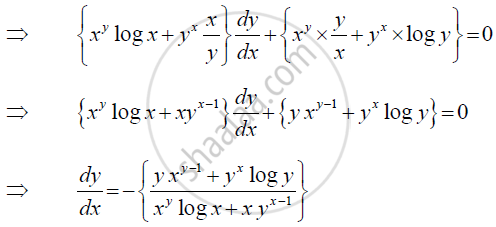
if `x^y + y^x = a^b`then Find `dy/dx`

Advertisements

उत्तर

Given that,

`x^y + y^x = a^b`
=> `e^(ylogx) + e^(xlogy) = a^b`

On differentiating both sides with respect to x, we get

shaalaa.com
  क्या इस प्रश्न या उत्तर में कोई त्रुटि है?
2016-2017 (March) All India Set 1

संबंधित प्रश्न

Find `bb(dy/dx)` in the following:

2x + 3y = sin y


Find `bb(dy/dx)` in the following:

x2 + xy + y2 = 100


Find `bb(dy/dx)` in the following:

`y = sin^(-1)((2x)/(1+x^2))`


Is |sin x| differentiable? What about cos |x|?


If f (x) = |x − 2| write whether f' (2) exists or not.


Find `"dy"/"dx"` ; if x = sin3θ , y = cos3θ


Find `"dy"/"dx"` ; if y = cos-1 `("2x" sqrt (1 - "x"^2))`


Find `"dy"/"dx"`, if : x = a(1 – cosθ), y = b(θ – sinθ)


If x = `(t + 1)/(t - 1), y = (t - 1)/(t + 1), "then show that"  y^2 + "dy"/"dx"` = 0.


Differentiate `cos^-1((1 - x^2)/(1 + x^2)) w.r.t. tan^-1 x.`


Find `(d^2y)/(dx^2)` of the following : x = a(θ – sin θ), y = a(1 – cos θ)


If x = at2 and y = 2at, then show that `xy(d^2y)/(dx^2) + a` = 0.


If y = sin (m cos–1x), then show that `(1 - x^2)(d^2y)/(dx^2) - x"dy"/"dx" + m^2y` = 0.


Find the nth derivative of the following:

`(1)/x`


Find the nth derivative of the following : cos (3 – 2x)


Differentiate the following w.r.t. x : `cos^-1((sqrt(1 + x) - sqrt(1 - x))/2)`


If x sin (a + y) + sin a . cos (a + y) = 0, then show that `"dy"/"dx" = (sin^2(a + y))/(sina)`.


If log y = log (sin x) – x2, show that `(d^2y)/(dx^2) + 4x "dy"/"dx" + (4x^2 + 3)y` = 0.


Choose the correct alternative.

If `"x"^4."y"^5 = ("x + y")^("m + 1")` then `"dy"/"dx" = "y"/"x"` then m = ?


`(dy)/(dx)` of `xy + y^2 = tan x + y` is


Find `(dy)/(dx)` if x + sin(x + y) = y – cos(x – y)


`"If" log(x+y) = log(xy)+a  "then show that", dy/dx=(-y^2)/x^2`


If log(x+y) = log(xy) + a then show that, `dy/dx = (-y^2)/x^2`


Find `dy/dx if , x = e^(3t) , y = e^sqrtt`


Find `dy/dx` if, x = e3t, y = `e^sqrtt`


Find `dy/dx` if, `x = e^(3t), y = e^sqrtt`


If log(x + y) = log(xy) + a then show that, `dy/dx = (-y^2)/x^2`


Share
Notifications

Englishहिंदीमराठी


      Forgot password?
Use app×