Advertisements
Advertisements
Question
If newborns are produced at the age of menopause, they may be with some abnormalities. Why?
Advertisements
Solution
- A female has millions of oocytes at the time of birth and new ova are not formed thereafter.
- Menopause occurs at approximately 40-50 years of age and hence fewer numbers of eggs are present with reduced fertility since the oocytes have aged.
- Their ability to divide diminishes and they may not be able to complete meiotic division properly.
- Fertilization of such oocytes may result in the production of genetic abnormalities (like Down’s syndrome) in offsprings.
Hence, if newborns are produced at the age of menopause, they may be with some abnormalities.
APPEARS IN
RELATED QUESTIONS
Women are often blamed for producing female children. Consequently, they are ill-treated and ostracized. How will you address this issue scientifically if you were to conduct an awareness programme to highlight the values involved?
______ type of reproduction occurs without fusion of gametes.
Give scientific reason.
Older women are more likely to give birth to children with some abnormalities.
Mammalian egg is ____________.
Mention the differences between spermiogenesis and spermatogenesis.
Complete the analogy.
1 primary spermatocyte : 4 spermatozoa :: 1 primary oocyte : ____________.
Which of the following enter the maturation phase of oogenesis?
The secondary oocyte enter into the fallopian tube through the ______.
Identify the correct stages (P - S) in the given diagram of spermatogenesis.
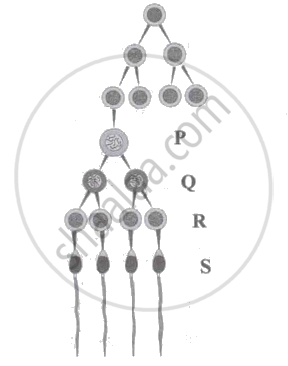
Which of the following is diploid?
Which of the following events take place during spermatogenesis?
Find out the CORRECT sequence of spermatogenesis.
Acrosome reaction in sperm is triggered by ______.
Corona radia is made up of ______.
How many sperms are formed from 4 primary spermatocytes?
The process of release of spermatozoa from Sertoli cells into cavity of the seminiferous tubules is called ______.
The region of the root tip whose cells undergo rapid elongation and enlargement and are responsible for the growth of the root in length is called the:
During spermatogenesis meiosis occurs in ______.
Draw a labelled diagram of a section through the ovary.
Select a correct pair of cells with identical set of chromosomes.
