If α and β are the zeros of the quadratic polynomial f(x) = 6x^2 + x – 2, find the value of α/β + β/α.
Advertisements
Question
If α and β are the zeros of the quadratic polynomial f(x) = 6x2 + x – 2, find the value of `alpha/beta + beta/alpha`.
Advertisements
Solution
f(x) = 6x2 + x – 2
Since α and β are the zeroes of the given polynomial
∴ Sum of zeroes [α + β] `=(-1)/6`
Product of zeroes `(alphabeta)=(-1)/3`
`=alpha/beta+beta/alpha=(alpha^2+beta^2)/(alphabeta)=((alpha+beta)^2-2alphabeta)/(alphabeta)`
= `((1/6)^2-2xx((-1)/3))/(-1/3)`
= `(1/36 + 2/3)/((-1)/3)`
= `((1 + 24)/36)/((-1)/3)`
= `(25/36)/((-1)/3)`
= `(-25)/12`
= `alpha/beta + beta/alpha = (-25)/12`
APPEARS IN
RELATED QUESTIONS
Prove relation between the zeros and the coefficient of the quadratic polynomial ax2 + bx + c
Find the zeroes of the following quadratic polynomial and verify the relationship between the zeroes and the coefficients.
4u2 + 8u
Find the zeroes of the following quadratic polynomial and verify the relationship between the zeroes and the coefficients:
t2 – 15
Find a cubic polynomial with the sum, sum of the product of its zeroes taken two at a time, and the product of its zeroes as 2, − 7, − 14 respectively
Find the zeroes of the following quadratic polynomials and verify the relationship between the zeroes and the coefficients
`f(x)=x^2-(sqrt3+1)x+sqrt3`
Find the zeros of the following quadratic polynomial and verify the relationship between the zeros and the coefficients:
g(x) = a(x2 + 1) – x(a2 + 1)
If α and β are the zeroes of the quadratic polynomial f(x) = ax2 + bx + c, then evaluate `1/(aalpha + b) + 1/(abeta + b)`.
If the squared difference of the zeros of the quadratic polynomial f(x) = x2 + px + 45 is equal to 144, find the value of p.
If one zero of the quadratic polynomial f(x) = 4x2 – 8kx – 9 is negative of the other, find the value of k.
Verify that 5, –2 and `1/3` are the zeroes of the cubic polynomial p(x) = (3x3 – 10x2 – 27x + 10) and verify the relation between its zeros and coefficients.
On dividing 3x3 + x2 + 2x + 5 is divided by a polynomial g(x), the quotient and remainder are (3x – 5) and (9x + 10) respectively. Find g(x).
If 3 and –3 are two zeroes of the polynomial (x4 + x3 – 11x2 – 9x + 18), find all the zeroes of the given polynomial.
If α, β are the zeroes of the polynomial f(x) = 5x2 – 7x + 1 then `1/α + 1/β = ?`
An asana is a body posture, originally and still a general term for a sitting meditation pose, and later extended in hatha yoga and modern yoga as exercise, to any type of pose or position, adding reclining, standing, inverted, twisting, and balancing poses. In the figure, one can observe that poses can be related to representation of quadratic polynomial.


The zeroes of the quadratic polynomial `4sqrt3"x"^2 + 5"x" - 2sqrt3` are:
Basketball and soccer are played with a spherical ball. Even though an athlete dribbles the ball in both sports, a basketball player uses his hands and a soccer player uses his feet. Usually, soccer is played outdoors on a large field and basketball is played indoor on a court made out of wood. The projectile (path traced) of soccer ball and basketball are in the form of parabola representing quadratic polynomial.

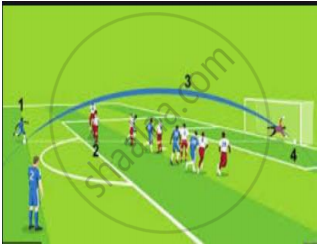
What will be the expression of the polynomial?
Find the zeroes of the following polynomials by factorisation method and verify the relations between the zeroes and the coefficients of the polynomials:
t3 – 2t2 – 15t
Find the zeroes of the following polynomials by factorisation method and verify the relations between the zeroes and the coefficients of the polynomials:
`v^2 + 4sqrt(3)v - 15`
Find the zeroes of the following polynomials by factorisation method and verify the relations between the zeroes and the coefficients of the polynomials:
`7y^2 - 11/3 y - 2/3`
If α, β are zeroes of the quadratic polynomial x2 – 5x + 6, form another quadratic polynomial whose zeroes are `1/α, 1/β`.
For the cubic equation \[ ax^{3} + bx^{2} + cx + d = 0 \] with roots \[ \alpha, \beta, \gamma \], the product of the roots \( \alpha\beta\gamma \) equals:
