If α and β are the zeros of the quadratic polynomial f(x) = 6x^2 + x – 2, find the value of α/β + β/α.
Advertisements
प्रश्न
If α and β are the zeros of the quadratic polynomial f(x) = 6x2 + x – 2, find the value of `alpha/beta + beta/alpha`.
Advertisements
उत्तर
f(x) = 6x2 + x – 2
Since α and β are the zeroes of the given polynomial
∴ Sum of zeroes [α + β] `=(-1)/6`
Product of zeroes `(alphabeta)=(-1)/3`
`=alpha/beta+beta/alpha=(alpha^2+beta^2)/(alphabeta)=((alpha+beta)^2-2alphabeta)/(alphabeta)`
= `((1/6)^2-2xx((-1)/3))/(-1/3)`
= `(1/36 + 2/3)/((-1)/3)`
= `((1 + 24)/36)/((-1)/3)`
= `(25/36)/((-1)/3)`
= `(-25)/12`
= `alpha/beta + beta/alpha = (-25)/12`
APPEARS IN
संबंधित प्रश्न
If α and β are the zeros of the quadratic polynomial f(x) = ax2 + bx + c, then evaluate α - β
If 𝛼 and 𝛽 are the zeros of the quadratic polynomial f(x) = x2 − 5x + 4, find the value of `1/alpha+1/beta-2alphabeta`
If α and β are the zeros of the quadratic polynomial f(t) = t2 − 4t + 3, find the value of α4β3 + α3β4.
If If α and β are the zeros of the quadratic polynomial f(x) = x2 – 2x + 3, find a polynomial whose roots are `(alpha-1)/(alpha+1)` , `(beta-1)/(beta+1)`
Find the zeroes of the quadratic polynomial` (x^2 ˗ 5)` and verify the relation between the zeroes and the coefficients.
Find the zeroes of the quadratic polynomial (3x2 – x – 4) and verify the relation between the zeroes and the coefficients.
Find the quadratic polynomial whose zeroes are `2/3` and `-1/4` Verify the relation between the coefficients and the zeroes of the polynomial.
Find the quadratic polynomial, sum of whose zeroes is 8 and their product is 12. Hence, find the zeroes of the polynomial.
Find the quadratic polynomial, the sum of whose zeroes is `(5/2)` and their product is 1. Hence, find the zeros of the polynomial.
Find the quadratic polynomial, sum of whose zeroes is `sqrt2` and their product is `(1/3)`.
Define a polynomial with real coefficients.
If two zeros x3 + x2 − 5x − 5 are \[\sqrt{5}\ \text{and} - \sqrt{5}\], then its third zero is
Case Study -1
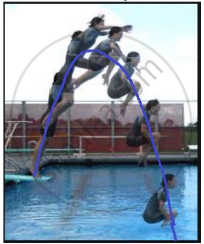
The figure given alongside shows the path of a diver, when she takes a jump from the diving board. Clearly it is a parabola.
Annie was standing on a diving board, 48 feet above the water level. She took a dive into the pool. Her height (in feet) above the water level at any time ‘t’ in seconds is given by the polynomial h(t) such that h(t) = -16t2 + 8t + k.
The zeroes of the polynomial r(t) = -12t2 + (k - 3)t + 48 are negative of each other. Then k is ______.
The number of polynomials having zeroes as –2 and 5 is ______.
If the zeroes of a quadratic polynomial ax2 + bx + c are both positive, then a, b and c all have the same sign.
Given that `sqrt(2)` is a zero of the cubic polynomial `6x^3 + sqrt(2)x^2 - 10x - 4sqrt(2)`, find its other two zeroes.
If α, β are zeroes of quadratic polynomial 5x2 + 5x + 1, find the value of α–1 + β–1.
For the cubic equation \[ ax^{3} + bx^{2} + cx + d = 0 \] with roots \[ \alpha, \beta, \gamma \], the pairwise product \( \alpha\beta + \beta\gamma + \gamma\alpha \) equals:
A quadratic equation whose roots are \[ \alpha, \beta \] can be written as:
