Advertisements
Advertisements
Question
If a, b and c are in continued proportion, prove that `(a^2 + ab + b^2)/(b^2 + bc + c^2) = a/c`
Advertisements
Solution
Given, a, b and c are in continued proportion.
Therefore,
`a/b = b/c`
ac = b2
Here,
`(a^2 + ab + b^2)/(b^2 + bc + c^2) = (a^2 + ab + ac)/(ac + bc + c^2)`
= `(a(a + b + c))/(c(a + b + c))`
= `a/c`
Hence proved.
APPEARS IN
RELATED QUESTIONS
Find the mean proportion of the following :
ab3 and a3b
If y is the mean proportional between x and y; show that y(x+z) is the mean p roporti ona I between x2+ y2 and y2+ z2
If a, b, c are in continued proportion, prove that a : c = (a2 + b2) : (b2 + c2).
If x + 5 is the mean proportion between x + 2 and x + 9, find the value of x.
Write (T) for true and (F) for false in case of the following:
51 : 68 : : 85 : 102
If the cost of 14 m of cloth is Rs 1890, find the cost of 6 m of cloth.
Are 30, 40, 45, and 60 in proportion?
Bachhu Manjhi earns Rs. 24000 in 8 months. At this rate, in how many months does he earn Rs. 42000?
Unequal masses will not balance on a fulcrum if they are at equal distance from it; one side will go up and the other side will go down.
Unequal masses will balance when the following proportion is true:
`("mass"1)/("length"2) = ("mass"2)/("length"1)`

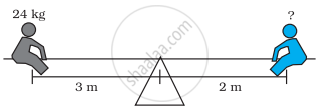
Two children can be balanced on a seesaw when
`("mass"1)/("length"2) = ("mass"2)/("length"1)`. The child on the left and child on the right are balanced. What is the mass of the child on the right?
The first, third, and fourth terms of a proportion are 9, 24, and 32. Find the second term.
