Advertisements
Advertisements
Questions
The following numbers, K + 3, K + 2, 3K – 7 and 2K – 3 are in proportion. Find k.
The numbers k + 3, k + 2, 3k – 7 and 2k – 3 are in proportion find k.
Advertisements
Solution
k + 3, k + 2, 3k − 7 and 2k − 3 are in proportional then
⇒ `(k + 3)/(k + 2) = (3k - 7)/(2k - 3)`
⇒ (k + 3) (2k − 3) = (k + 2) (3k − 7)
Left side:
(k + 3) (2k − 3) = 2k2 − 3k + 6k − 9
Right side:
(k + 2) (3k − 7) = 3k2 − 7k + 6k − 14
⇒ 2k2 − 3k + 6k − 9 = 3k2 − 7k + 6k − 14
⇒ 2k2 + 3k − 9 = 3k2 − k − 14
⇒ 3k2 − k − 14 − 2k2 − 3k + 9 = 0
⇒ k2 − 4k − 5 = 0
⇒ k2 − 5k + k − 5 = 0
⇒ k (k − 5) + 1(k − 5) = 0
⇒ k = 5 or k = −1
RELATED QUESTIONS
If a, b, c are in continued proportion and a(b – c) = 2b, prove that: `a - c = (2(a + b))/a`.
Find the third proportional to:
x - y, x2 - y2
Find the fourth proportional to `(1)/(3), (1)/(4), (1)/(5)`
Find the mean proportion of: (a – b) and (a³ – a²b), a> b
If a, 12, 16 and b are in continued proportion find a and b.
If 9 kg of rice costs Rs 327.60, what will be the cost of 50 kg of rice?
If a, b, c, d are in continued proportion, prove that: (a2 – b2) (c2 – d2) = (b2 – c2)2
If two ratios are equal, then they are in ______.
Sleeping time of a python in a 24 hour clock is represented by the shaded portion in the following figure.
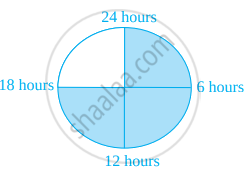
The ratio of sleeping time to awaking time is ______.
The mean proportional between 4 and 9 is ______.
