Advertisements
Advertisements
Question
If `veca = 4hati + 6hatj` and `vecb = 3hatj + 4hatk`, then the vector form of the component of `veca` along `vecb` is ______.
Options
`18/5(3hati + 4hatk)`
`18/25(3hatj + 4hatk)`
`18/5(3hati + 4hatk)`
`18/25(4hati + 6hatj)`
Advertisements
Solution
If `veca = 4hati + 6hatj` and `vecb = 3hatj + 4hatk`, then the vector form of the component of `veca` along `vecb` is `underlinebb(18/25(3hatj + 4hatk))`.
Explanation:
Vector component of `veca` along `vecb` = `((veca.vecb)/|vecb|^2)vecb = 18/25(3hatj + 4hatk)`.
APPEARS IN
RELATED QUESTIONS
If `veca=4hati-hatj+hatk` then find a unit vector parallel to the vector `veca+vecb`
For given vectors, `veca = 2hati - hatj + 2hatk` and `vecb = -hati + hatj - hatk`, find the unit vector in the direction of the vector `veca +vecb`.
Find a vector in the direction of vector `5hati - hatj +2hatk` which has a magnitude of 8 units.
Show that the direction cosines of a vector equally inclined to the axes OX, OY, and OZ are `pm1/sqrt3, 1/sqrt3, 1/sqrt3`.
Identify the unit vector in the following.
The position vector particle has a length of 1m and makes 30° with the x-axis. What are the lengths of the x and y components of the position vector?
Compare the components for the following vector equations
(a) `"T"hatj - "mg"hatj = "ma"hatj`
(b) `vecT + vecF = vecA + vecB`
(c) `vecT - vecF = vecA - vecB`
(d) `"T"hatj + "mg"hatj = "ma"hatj`
If `overline(a),overline(b),overline(c)` are non-coplanar vectors and λ is a real number then `[lambda(overline(a)+overline(b))lambda^2overline(b) lambda overline(c)]=[overline(a) overline(b)+overline(c) overline(b)]` for ______.
Find the vector component of the vector with initial point (2, 1) and terminal point (–5, 7).
Unit vector perpendicular to the plane of the triangle ABC with position vectors `veca, vecb, vecc` of the vertices A, B, C is ______.
If a line makes angles 120° and 60° with the positive directions of X and Z axes respectively then the angle made by the line with positive Y-axis is ______.
Two vectors `veca = a_1 hati + a_2 hatj + a_3 hatk` and `vecb = b_1 hati + b_2 hatj + b_3 hatk` are collinear if ______.
If `4hati - 5hatj + hatk, 2hati + 3hatj + 3hatk` and `xhati + yhatj + zhatk` represent the sides AB, BC and AC respectively of a triangle ABC, then find x, y, z.
If `veca = 3hati - 2hatj + hatk` and `vecb = 2hati - 4hatj - 3hatk` then the value of `|veca - 2vecb|` will be ______.
Shown below is a cuboid. Find `vec(BA).vec(BC)`.
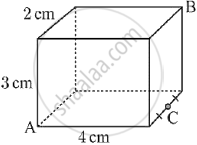
Check whether the vectors `2hati + 2hatj + 3hatk , -3hati + 3hatj + 2hatk and 3hati + 4hatk` form a triangle or not.
What is the name given to \[\vec{OP}=x\hat{i}+y\hat{j}+z\hat{k}\]?
Which expression gives the magnitude of \[\vec{r}=x\hat{i}+y\hat{j}+z\hat{k}\]?
Which expression represents scalar multiplication of \[\vec{a}=a_1\hat{i}+a_2\hat{j}+a_3\hat{k}\] by \[\lambda\]?
When are two vectors equal?
What is the unit vector in the same direction as \[\vec{a}=\vec{i}-2\vec{j}\]?
Which vector has magnitude \[7\] units in the direction of \[\vec{a}=\vec{i}-2\vec{j}\]?
