Advertisements
Advertisements
प्रश्न
If `veca = 4hati + 6hatj` and `vecb = 3hatj + 4hatk`, then the vector form of the component of `veca` along `vecb` is ______.
पर्याय
`18/5(3hati + 4hatk)`
`18/25(3hatj + 4hatk)`
`18/5(3hati + 4hatk)`
`18/25(4hati + 6hatj)`
Advertisements
उत्तर
If `veca = 4hati + 6hatj` and `vecb = 3hatj + 4hatk`, then the vector form of the component of `veca` along `vecb` is `underlinebb(18/25(3hatj + 4hatk))`.
Explanation:
Vector component of `veca` along `vecb` = `((veca.vecb)/|vecb|^2)vecb = 18/25(3hatj + 4hatk)`.
APPEARS IN
संबंधित प्रश्न
For given vectors, `veca = 2hati - hatj + 2hatk` and `vecb = -hati + hatj - hatk`, find the unit vector in the direction of the vector `veca +vecb`.
Find a vector in the direction of vector `5hati - hatj +2hatk` which has a magnitude of 8 units.
Identify the unit vector in the following.
Compare the components for the following vector equations
(a) `"T"hatj - "mg"hatj = "ma"hatj`
(b) `vecT + vecF = vecA + vecB`
(c) `vecT - vecF = vecA - vecB`
(d) `"T"hatj + "mg"hatj = "ma"hatj`
If `overlinea`, `overlineb` and `overlinec` are three non-coplanar vectors then `(overlinea + overlineb + overlinec).[(overlinea + overlineb) xx (overlinea + overlinec)]` = ______
If the horizontal and vertical components of a force are negative, then that force is acting in between
Find the vector component of the vector with initial point (2, 1) and terminal point (–5, 7).
Two vectors `veca = a_1 hati + a_2 hatj + a_3 hatk` and `vecb = b_1 hati + b_2 hatj + b_3 hatk` are collinear if ______.
If `4hati - 5hatj + hatk, 2hati + 3hatj + 3hatk` and `xhati + yhatj + zhatk` represent the sides AB, BC and AC respectively of a triangle ABC, then find x, y, z.
Check whether the vectors `2hati + 2hatj +3hatk, -3hati +3hatj +2hatk` and `3hati +4hatk` form a triangle or not.
Check whether the vectors `2hati + 2hatj+ 3hatk`, `-3hati + 3hatj +2hatk` and `3hati + 4hatk` form a triangle or not.
If `veca = 3hati - 2hatj + hatk` and `vecb = 2hati - 4hatj - 3hatk` then the value of `|veca - 2vecb|` will be ______.
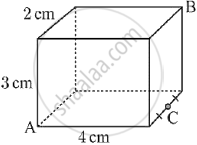
Shown below is a cuboid. Find `vec(BA).vec(BC)`.
Check whether the vectors `2hati + 2hatj + 3hatk , -3hati + 3hatj + 2hatk and 3hati + 4hatk` form a triangle or not.
If \[P(x,y,z)\] is a point, what is its position vector?
For \[\vec{a}=a_1\hat{i}+a_2\hat{j}+a_3\hat{k}\], which quantities are called the components of \[\vec{a}\]?
If \[\vec{a}=a_1\hat{i}+a_2\hat{j}+a_3\hat{k}\] and \[\vec{b}=b_1\hat{i}+b_2\hat{j}+b_3\hat{k}\], what is \[\vec{a}+\vec{b}\]?
Which expression represents scalar multiplication of \[\vec{a}=a_1\hat{i}+a_2\hat{j}+a_3\hat{k}\] by \[\lambda\]?
When are two vectors equal?
Find \[x\], \[y\], and \[z\] so that \[\vec{a}=x\hat{i}+2\hat{j}+z\hat{k}\] and \[\vec{b}=2\hat{i}+y\hat{j}+\hat{k}\] are equal.
What is the magnitude of \[\vec{a}=\vec{i}-2\vec{j}\]?
Which vector has magnitude \[7\] units in the direction of \[\vec{a}=\vec{i}-2\vec{j}\]?
