Advertisements
Advertisements
Question
If `veca=4hati-hatj+hatk` then find a unit vector parallel to the vector `veca+vecb`
Advertisements
Solution
`veca=4hati-hatj+hatk,`
`veca+vecb=(4hati-hatj+hatk)+(2hati-2hatj+hatk)`
`=6hati-3hatj+2hatk`
unit vector parallel to `(veca+vecb)=(veca+vecb)/(|veca+vecb|)`
`=(6hati-3hatj+2hatk)/sqrt(36+9+4)`
`=(6hati-3hatj+2hatk)/sqrt49`
`=6/7hati-3/7hatj+2/7hatk`
APPEARS IN
RELATED QUESTIONS
For given vectors, `veca = 2hati - hatj + 2hatk` and `vecb = -hati + hatj - hatk`, find the unit vector in the direction of the vector `veca +vecb`.
Find a vector in the direction of vector `5hati - hatj +2hatk` which has a magnitude of 8 units.
Compare the components for the following vector equations
(a) `"T"hatj - "mg"hatj = "ma"hatj`
(b) `vecT + vecF = vecA + vecB`
(c) `vecT - vecF = vecA - vecB`
(d) `"T"hatj + "mg"hatj = "ma"hatj`
If `overlinea`, `overlineb` and `overlinec` are three non-coplanar vectors then `(overlinea + overlineb + overlinec).[(overlinea + overlineb) xx (overlinea + overlinec)]` = ______
If `overline(a),overline(b),overline(c)` are non-coplanar vectors and λ is a real number then `[lambda(overline(a)+overline(b))lambda^2overline(b) lambda overline(c)]=[overline(a) overline(b)+overline(c) overline(b)]` for ______.
If the horizontal and vertical components of a force are negative, then that force is acting in between
Find the vector component of the vector with initial point (2, 1) and terminal point (–5, 7).
Unit vector perpendicular to the plane of the triangle ABC with position vectors `veca, vecb, vecc` of the vertices A, B, C is ______.
If a line makes angles 120° and 60° with the positive directions of X and Z axes respectively then the angle made by the line with positive Y-axis is ______.
Two vectors `veca = a_1 hati + a_2 hatj + a_3 hatk` and `vecb = b_1 hati + b_2 hatj + b_3 hatk` are collinear if ______.
Check whether the vectors `2hati +2hatj +3hatk,-3hati +3hatj +2hatk and 3hati + 4hatk` From a triangle or not.
Check whether the vectors `2hati + 2hatj+ 3hatk`, `-3hati + 3hatj +2hatk` and `3hati + 4hatk` form a triangle or not.
If `veca = 3hati - 2hatj + hatk` and `vecb = 2hati - 4hatj - 3hatk` then the value of `|veca - 2vecb|` will be ______.
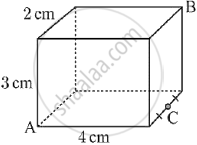
Shown below is a cuboid. Find `vec(BA).vec(BC)`.
Check whether the vectors `2hati + 2hatj + 3hatk , -3hati + 3hatj + 2hatk and 3hati + 4hatk` form a triangle or not.
If \[P(x,y,z)\] is a point, what is its position vector?
For \[\vec{a}=a_1\hat{i}+a_2\hat{j}+a_3\hat{k}\], which quantities are called the components of \[\vec{a}\]?
Which expression gives the magnitude of \[\vec{r}=x\hat{i}+y\hat{j}+z\hat{k}\]?
If \[\vec{a}=a_1\hat{i}+a_2\hat{j}+a_3\hat{k}\] and \[\vec{b}=b_1\hat{i}+b_2\hat{j}+b_3\hat{k}\], what is \[\vec{a}+\vec{b}\]?
If \[\vec{a}=a_1\hat{i}+a_2\hat{j}+a_3\hat{k}\] and \[\vec{b}=b_1\hat{i}+b_2\hat{j}+b_3\hat{k}\], what is \[\vec{a}-\vec{b}\]?
Find \[x\], \[y\], and \[z\] so that \[\vec{a}=x\hat{i}+2\hat{j}+z\hat{k}\] and \[\vec{b}=2\hat{i}+y\hat{j}+\hat{k}\] are equal.
What is the unit vector in the same direction as \[\vec{a}=\vec{i}-2\vec{j}\]?
Which vector has magnitude \[7\] units in the direction of \[\vec{a}=\vec{i}-2\vec{j}\]?
