Advertisements
Advertisements
Question
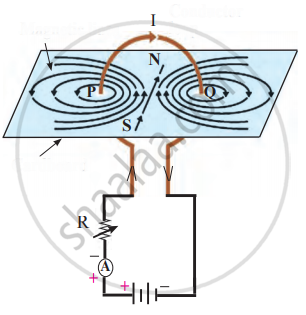
Identify the given figure, write the labels of it.
Advertisements
Solution
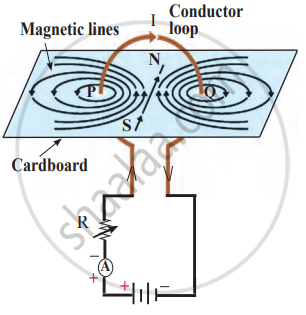
Current-carrying loop
APPEARS IN
RELATED QUESTIONS
Which effect of current can be utilised in detecting a current carrying wire concealed in a wall?
For the coil in the diagram below, when the switch is pressed:
(a) what is the polarity of end A?
(b) which way will the compass point then?

Which way does the wire in the diagram below tend to move?
A coil is connected to a galvanometer. When the N-pole of magnet is pushed into the coil, the galvanometer deflected to the right. What deflection, if any, is observed when:
the S-pole is inserted?
How should the electric lamps in a building be connected so that the switching on or off in a room has no effect on other lamps in the same building?
Observe the following diagram and choose the correct alternative:

A uniform magnetic field exists in the plane of paper pointing from left to right as shown in Figure. In the field an electron and a proton move as shown. The electron and the proton experience

A magnetic compass shows a deflection when placed near a current carrying wire. How will the deflection of the compass get affected if the current in the wire is increased? Support your answer with a reason.
Paheli does not have a night lamp in her room. She covered the bulb of her room with a towel at the night to get dim light. Has she taken the right step? Give one reason to justify your answer.
Why do we cover plug pin holes which are within the reach of children with cellotape or a plastic cover when not in use?
Boojho made an electromagnet by winding 50 turns of wire over an iron screw. Paheli also made an electromagnet by winding 100 turns over a similar iron screw. Which electromagnet will attract more pins? Give reason.
What do you mean by the magnetic effect?
What are MCBs? How do they work?
An electric bell contains an ______, consisting of coils of insulated wire wound around
iron rods.
Define the magnetic effect of electric current.
The figure given below shows the magnetic field around the conductor. Study it and answer the questions:

- What changes are caused by increasing current?
- What do you see when the magnetic needle is kept a little away from the wire?
- In the second part of the figure, the iron filings arrange themselves in a circular manner around the wire. Why does this happen?
Make four electromagnets with 20, 40, 60 and 80 turns. Connect them one by one to a battery of 2 cells. Bring the electromagnet near a box of pins. Count the number of pins attracted by it. Compare the strengths of the electromagnets.
