Advertisements
Advertisements
Question
Advertisements
Solution
A simple method for finding the velocity of sound is echo or open air method.
For example: A person stands at a known distance (d m) from a cliff and fires a pistol and simultaneously starts the stop watch. He stops the stop-watch as soon as he hears the echo. The distance traveled by sound during this time (t seconds) is twice the distance (2d m). The velocity (v) of sound is then calculated as under:
Velocity of sound= `"distance travelled"/" time taken" = (2"d")/"t"`
By repeating the experiment two or three times, the average velocity of sound can be calculated.
APPEARS IN
RELATED QUESTIONS
Define amplitude term in relation to a wave.
The following diagram shows three ways in which the string of an instrument can vibrate.
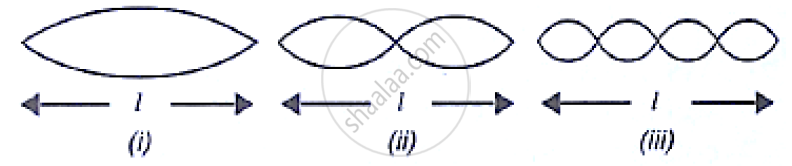
(a) which of the diagram shows the principal note?
(b) which has the frequency four times that of the first?
(c) what is the ratio of the frequency of the vibration in (i) and (ii)?
Name the principle on which a soundboard works.
What is a megaphone ? Name the principle on which a megaphone works.
Explain how is the principle of echo used by
(a) The bat during its flight at night,
(b) The dolphin to locate small fish as its prey.
Write the approximate value of the speed of sound in water.
Waves produced on the surface of the water are formed to move with a velocity of 24 ms−1. If the wavelength of these waves equals 20 cm. find the
(i) frequency (no. of waves produced per second)
(ii) the time period (i.e. the time required to produce one wave) for these waves.
