Advertisements
Advertisements
Question
(i) A man stands at a distance of 68 m from a cliff and fires a gun. After what time interval will he hear the echo, if the speed of sound in air is 340 ms−1?
(ii) If the man had been standing at a distance of 12 m from the cliff would he have heard a clear echo?
Advertisements
Solution
(i) d = 68 m, v = 340 ms−1.
∴ Time taken = `"total distance"/"speed"=68/340=1/5`
= 0.2 s (second)
So echo is heard after 2t i.e.
0.2 × 2 = 0.4 sec.
(ii) If man had been standing at a distance 12 m then
t = `"2d"/"v"=(2xx12)/340=24/340` = 0.07 sec.
which is less than 0.1 sec.
Hence, man can not hear a clear echo.
RELATED QUESTIONS
The displacement distance graph of two sound waves A and B, travelling in a medium, are as shown in the diagram below.
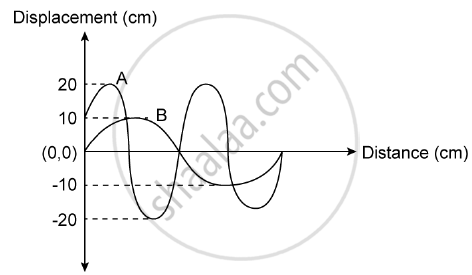
Study the two sound waves and compare their:
- Amplitudes
- Wavelengths
Define wavelength term in relation to a wave.
State two differences between the light and sound waves.
How do bats avoid obstacles in their way, when in flight?
What do you mean by reflection of sound? State one condition for the reflection of a sound wave. Name a device in which reflection of sound wave is used.
Write the approximate value of the speed of sound in air.
What is meant by echo depth sounding?
A sound wave whose frequency is 5000 Hz travels in air and then hits the water surface. The ratio of its wavelengths in water and air is ______.
