Advertisements
Advertisements
प्रश्न
(i) A man stands at a distance of 68 m from a cliff and fires a gun. After what time interval will he hear the echo, if the speed of sound in air is 340 ms−1?
(ii) If the man had been standing at a distance of 12 m from the cliff would he have heard a clear echo?
Advertisements
उत्तर
(i) d = 68 m, v = 340 ms−1.
∴ Time taken = `"total distance"/"speed"=68/340=1/5`
= 0.2 s (second)
So echo is heard after 2t i.e.
0.2 × 2 = 0.4 sec.
(ii) If man had been standing at a distance 12 m then
t = `"2d"/"v"=(2xx12)/340=24/340` = 0.07 sec.
which is less than 0.1 sec.
Hence, man can not hear a clear echo.
संबंधित प्रश्न
The displacement distance graph of two sound waves A and B, travelling in a medium, are as shown in the diagram below.
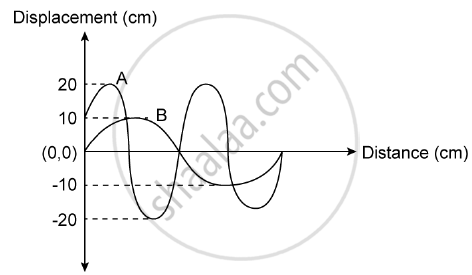
Study the two sound waves and compare their:
- Amplitudes
- Wavelengths
A wave passes from one medium to another medium. Mention one property of the wave out of speed, frequency or wavelength which changes.
The following diagram shows three ways in which the string of an instrument can vibrate.
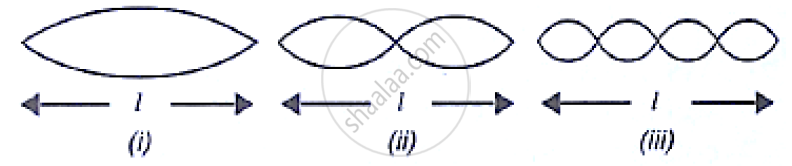
(a) which of the diagram shows the principal note?
(b) which has the frequency four times that of the first?
(c) what is the ratio of the frequency of the vibration in (i) and (ii)?
What is a megaphone ? Name the principle on which a megaphone works.
What is meant by echo depth sounding?
State two factors on which the natural frequency of a body depends.
Waves produced on the surface of the water are formed to move with a velocity of 24 ms−1. If the wavelength of these waves equals 20 cm. find the
(i) frequency (no. of waves produced per second)
(ii) the time period (i.e. the time required to produce one wave) for these waves.
Explain reflection at the boundary of a rarer medium.
Explain Reflection at curved surfaces.
