Advertisements
Advertisements
Question
How will you convert the following in not more than two steps:
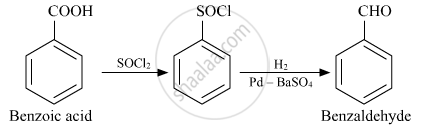
Benzoic acid to Benzaldehyde
Advertisements
Solution
Benzoic acid to Benzaldehyde
APPEARS IN
RELATED QUESTIONS
Derive van’t Hoff general solution equation.
How van’t Hoff factor is related to the degree of dissociation?
Give reasons for the following
Elevation of the boiling point of 1 M KCl solution is nearly double than that of 1 M sugar solution.
The Van't Hoff factor (i) for a dilute aqueous solution of the strong elecrolyte barium hydroxide is (NEET) ______.
The freezing point depression constant for water is 1.86° K Kg mol-1. If 5 g Na2SO4 is dissolved in 45 g water, the depression in freezing point is 3.64°C. The Vant Hoff factor for Na2SO4 is ______.
Phenol dimerizes in benzene having van’t Hoff factor 0.54. What is the degree of association?
The van’t Hoff factor (i) accounts for ____________.
The values of Van’t Hoff factors for KCl, NaCl and K2SO4, respectively, are ______.
Van't Hoff factor I is given by expression.
When 19.5 g of F – CH2 – COOH (Molar mass = 78 g mol−1), is dissolved in 500 g of water, the depression in freezing point is observed to be 1°C. Calculate the degree of dissociation of F – CH2 – COOH.
[Given: Kf for water = 1.86 K kg mol−1]
