Advertisements
Advertisements
प्रश्न
How will you convert the following in not more than two steps:
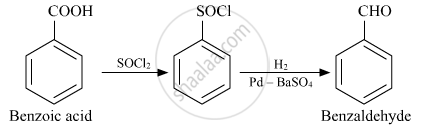
Benzoic acid to Benzaldehyde
Advertisements
उत्तर
Benzoic acid to Benzaldehyde
APPEARS IN
संबंधित प्रश्न
Derive van’t Hoff general solution equation.
How will you convert the following in not more than two steps:
Acetophenone to Benzoic acid
Phenol dimerizes in benzene having van’t Hoff factor 0.54. What is the degree of association?
The van’t Hoff factor (i) accounts for ____________.
We have three aqueous solutions of NaCl labelled as ‘A’, ‘B’ and ‘C’ with concentrations 0.1 M, 0.01 M and 0.001 M, respectively. The value of van’t Hoff factor for these solutions will be in the order ______.
Van’t Hoff factor i is given by the expression:
(i) i = `"Normal molar mass"/"Abnormal molar mass"`
(ii) i = `"Abnormal molar mass"/"Normal molar mass"`
(iii) i = `"Observed colligative property"/"Calculated colligative property"`
(iv) i = `"Calculated colligative property"/"Observed colligative property"`
A storage battery contains a solution of H2SO4 38% by weight. At this concentration, Van't Hoff Factor is 2.50. At the battery content freeze temperature will be ______ K.
(Kf = 1.86 K Kg mol−1)
Consider the reaction
\[\begin{bmatrix}\begin{array}{cc}
\phantom{.......}\ce{CH3}\\
\phantom{....}|\\
\ce{CH3CH2CH2 - \overset{⊕}{N} - CH2CH3}\\
\phantom{....}|\\
\phantom{.......}\ce{CH3}
\end{array}\end{bmatrix}\]\[\ce{OH^- ->[Heat] ?}\]
Which of the following is formed in a major amount?
A molecule M associates in a given solvent according to the equation \[\ce{M <=> (M)_n}\]. For a certain concentration of M, the van't Hoff factor was found to be 0.9 and the fraction of associated molecules was 0.2. The value of n is ______.
When 19.5 g of F – CH2 – COOH (Molar mass = 78 g mol−1), is dissolved in 500 g of water, the depression in freezing point is observed to be 1°C. Calculate the degree of dissociation of F – CH2 – COOH.
[Given: Kf for water = 1.86 K kg mol−1]
