Advertisements
Advertisements
Question
How was the bear punished when he attacked a beehive?
Advertisements
Solution
(i) The bear was hit on the nose, which bled.
(ii) He was put in chains for two days.
RELATED QUESTIONS
What are the Guru’s words of wisdom? When does the disciple remember them?
Based on your reading of the story answer the following question by choosing the correct option:
With reference to Hooper, the author says, “Every thing was going for him”. What does it imply?
So please, oh please, we beg, we pray,
Go throw your TV set away,
And in its place you can install
A lovely bookshelf on the wall.
Then fill the shelves with lots of books,
Ignoring all the dirty looks,
The Screams and yells,the bites and kicks,
And children hitting you with sticks-
Fear not, because we promise you
That, in about a week ot two
Of having nothing else to do,
They'll now begin to feel the need
Of having something to read.
And once they start - oh boy, oh boy!
You watch the slowly growing joy
That fills their hearts. They'll grow so keen
They'll wonder what they'd ever seen
In that ridiculous machine,
That nauseating, foul, unclean,
Repulsive television screen!
And later, each and every kid
Will love you more for what you did.
Read the lines given above and answer the question given below.
Will the children thank the parents? Why?
So after that, dimly, dimly, she sensed it, she was different and they knew her difference and kept away. There was talk that her father and mother were taking her back to Earth next year; it seemed vital to her that they do so, though it would mean the loss of thousands of dollars to her family. And so, the children hated her for all these reasons of big and little consequence. They hated her pale snow face, her waiting silence, her thinness, and her possible future. “Get away 1” The boy gave her another push. “What’re you waiting for?”Then, for the first time, she turned and looked at him. And what she was waiting for was in her eyes. “Well, don’t wait around here !” cried the boy savagely. “You won’t see nothing!” Her lips moved. “Nothing 1” he cried. “It was all a joke, wasn’t it?” He turned to the other children. “Nothing’s happening today. Is it ?”
Read the extract given below and answer the question that follow.
Why did the children hate her?
Find in the poem lines that match the following. Read both one after the other.
He recommends dogs.
How did the king reach the rishi’s ashram? Why did the two birds behave with the king differently?
- What steps did he take to save himself?
- Did his plan work? How?
Who made the pact with the Sun and why? How did the pact prove fruitful?
Discuss the question in pairs before you write the answer.
Who did he first choose as his master? Why did he leave that master?
There are twelve words hidden in this table. Six can be found horizontally and the remaining six vertically. All of them are describing words like ‘good’, ‘happy’, etc. The first letters of the words are given below:
Horizontal: H R F F S G
Vertical: A W S F L Q 2020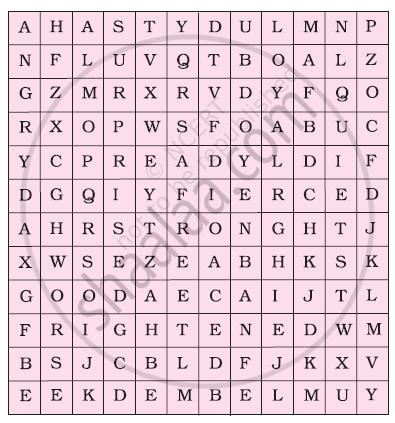
Multiple Choice Question:
A family is made of the people who ________
Answer the question.
Why does the poet want to know where the teachers go at four o’clock?
Multiple Choice Question:
What does the phrase pick their noses’ mean?
Multiple Choice Question:
What does the word ‘scribble’ mean?
Answer the following question:
Why was Rasheed upset?
"Since I don’t know when" suggests ...
The word ‘tip’ has only three letters but many meanings.
Match the word with its meanings below.
- finger tips – be about to say something
- the tip of your nose – make the boat overturn
- tip the water out of the bucket – the ends of one’s fingers
- have something on the tip of your tongue – give a rupee to him, to thank him
- tip the boat over-empty a bucket by tilting it
- tip him a rupee-the pointed end of your nose
- the tip of the bat – if you take this advice
- the police were tipped off – the bat lightly touched the ball
- if you take my tip – the end of the bat
- the bat tipped the ball – the police were told or warned
“You should be able to qualify with your eyes closed.” Who said these words and to whom?
Read the following passage carefully and answer the questions that follow:
|
That huge bell never stopped ringing. It got us out of bed, it summoned us for meals, it rang between class periods, it sent us unwillingly to bed. One morning it failed to ring, or rather, there was no bell to ring. Someone had removed it, and it wasn't found till late in the afternoon. What a glorious day! As there was no bell to rouse us, everyone got up late, and there was no morning PT. Some of us missed breakfast too. The teachers got confused and mixed up their classes. How could the school manage without it? Confusion reigned. Of course, no one owned up. It could have meant expulsion. Some suspicion fell on the Sports Captain because of our aversion to morning PT, but nothing could be proved. No one was very anxious to find the bell - we were quite happy without it - but it was finally discovered hanging from a branch of one of the trees. ‘It may have been Mr. Sharma,' surmised Brian. Mr. Sharma, our Maths teacher, was known to walk in his sleep. And sleepwalkers did funny things sometimes. ‘It could be Mool Chand himself,’ suggested Cyrus Satralkar. Mool Chand was the school chowkidar, who also had the job of banging the brass bell at appointed times. ‘Why would he throw it away?’ ‘He must be as fed up with ringing it as we are of hearing it.’ This was my theory. ‘Perhaps he wants a rise in salary.’ The identity of the culprit remained a mystery. Happily, the senior Hockey team went on a winning spree against all corners, and our month-end exits were restored. But soon there was another sensation. A girl was admitted to our class! The boys were scandalized. No girl had ever studied in our school before. We protested. ‘What’s the problem?’ asked Mr. Knight, our class master. ‘Haven’t you seen a girl before?’ ‘But - but. Sir ...’ Tata was our spokesman. ‘How will we concentrate on our studies?’ ‘When did you ever concentrate on your studies, Tata?’ ‘Are we going co-ed, sir?’ Adams wanted to know. ‘Not at all,’ said Mr. Knight. ‘This is a special case. She is the school accounts manager’s daughter, and he can’t afford the Girls school fees. So, I’m sure you’ll make her feel very welcome.’ The accountant was a popular man who also ran the school’s tuck shop and allowed most of us a certain amount of credit. All our objections faded away. At first, Sunita, our new entrant, was a bit of a distraction because, although she was very shy and demure, she had lovely curly hair, bright eyes, pink cheeks and a smile for everyone. All the boys were very polite and attentive to her and Brian in particular was always ready to help her. |
- For each word given below choose the correct meaning (as used in the passage) from the options provided: (3)
- summoned (line 1)
- totalled
- ordered
- requested
- shout
- aversion (line 10)
- hatred
- fear
- politeness
- creation
- restored (line 25)
- helped
- returned
- permit
- victory
- summoned (line 1)
- Answer the following questions briefly in your own words.
- Why did no one confess to having removed the missing bell? (1)
- Why did suspicion fall on the Sports Captain? (2)
- What made Brian think that it was Mr. Sharma? (2)
- Which sentence in the passage tells you that Mr. Knight thought poorly of Tata’s academic performance? (2)
- Why was the accountant a popular man? (2)
- In not more than 50 words describe the effects of the lost bell. (8)
Read the extract given below and answer the questions that follow:
|
Bassanio: Portia: |
- Who is on trial?
Why is this person on trial? [3] - Explain in your own words Bassanio’s request to portia in the given extract.
What reason does he give for his request? [3] - How does Portia respond to Bassanio's request? What TWO reasons does she give for her response? [3]
- Who does Bassanio refer to as ‘this cruel devil’? What is this person's response to Portia’s words in the given extract? [3]
- How is the ‘cruel devil’ punished at the end of the trial?
How fair, in your opinion, is this punishment? Justify your response. [4]
