Advertisements
Advertisements
Question
How is the structure of DNA organized?
Advertisements
Solution
DNA is the hereditary material, as it contains genetic information. It is a large molecule consisting of millions of nucleotides, so it is called a polynucleotide. Each nucleotide consists of three components.
(a) A sugar molecule – Deoxyribose sugar
(b) A nitrogenous base – There are two types of nitrogenous base in DNA they are
- Purines (Adenine and Guanine)
- Pyrimidines (Cytosine and Thymine)
(c) A phosphate group – The polynucleotide chains from a double helix. Nitrogenous bases in the centre are linked to sugar-phosphate units, which form the backbone of the DNA. Pairing between the nitrogenous bases is very specific and is always between purine and pyrimidine, linked by hydrogen bonds.
Adenine (A) links Thymine (T) with two hydrogen bonds [A=T]. Cytosine (C) links Guanine (G) with three hydrogen bonds (C = G). The hydrogen bonds between the nitrogenous bases make the DNA molecule stable. The nucleotides in a helix are joined together by phosphodiester bonds.
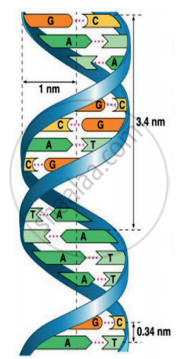
Structure of DNA
APPEARS IN
RELATED QUESTIONS
Correct the following statement if there is any mistake.
The four nitrogenous bases in the DNA are Guanine, Thiamine, Adrenaline and Cytosine.
Fill in the blanks:
There are two nucleic acids ______ and ______.
DNA strands are made up of phosphate groups, pentose sugar and four types of ______ bases.
Write the functional activity of the following structure:
DNA
How many codons are needed to specify three amino acids?
What is the biological significance of DNA?
Which of the following enzyme catalyse the removal of nucleotides from ends of DNA?
Which of the following basic proteins DNA is associated?
A nucleotide consists of three distinct components. Which of the following correctly identifies all three?
Which force type maintains strand integrity along the sugar-phosphate backbone of DNA?
