Advertisements
Advertisements
प्रश्न
How is the structure of DNA organized?
Advertisements
उत्तर
DNA is the hereditary material, as it contains genetic information. It is a large molecule consisting of millions of nucleotides, so it is called a polynucleotide. Each nucleotide consists of three components.
(a) A sugar molecule – Deoxyribose sugar
(b) A nitrogenous base – There are two types of nitrogenous base in DNA they are
- Purines (Adenine and Guanine)
- Pyrimidines (Cytosine and Thymine)
(c) A phosphate group – The polynucleotide chains from a double helix. Nitrogenous bases in the centre are linked to sugar-phosphate units, which form the backbone of the DNA. Pairing between the nitrogenous bases is very specific and is always between purine and pyrimidine, linked by hydrogen bonds.
Adenine (A) links Thymine (T) with two hydrogen bonds [A=T]. Cytosine (C) links Guanine (G) with three hydrogen bonds (C = G). The hydrogen bonds between the nitrogenous bases make the DNA molecule stable. The nucleotides in a helix are joined together by phosphodiester bonds.
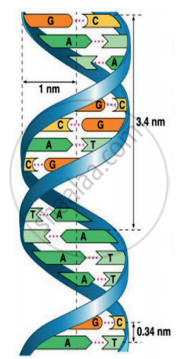
Structure of DNA
APPEARS IN
संबंधित प्रश्न
What are the rungs of the “DNA ladder” made of?
Fill in the blank:
DNA acts as director of ______ synthesis.
DNA strands are made up of phosphate groups, pentose sugar and four types of ______ bases.
Choose the correct answer :
RNA has uracil instead of ____________
Give Technical Term:
The individual having similar pair of genes.
If a DNA has 20 Adenine and 30 cytosine bases. What will be the total number of purine bases in the given sample?
What is the name given to the segments of DNA, which are responsible for the inheritance of a particular character?
A lysogen is a ______.
Which nitrogenous bases are classified as pyrimidines, characterized by their single-ringed structure?
