Advertisements
Advertisements
प्रश्न
How is the structure of DNA organized?
Advertisements
उत्तर
DNA is the hereditary material, as it contains genetic information. It is a large molecule consisting of millions of nucleotides, so it is called a polynucleotide. Each nucleotide consists of three components.
(a) A sugar molecule – Deoxyribose sugar
(b) A nitrogenous base – There are two types of nitrogenous base in DNA they are
- Purines (Adenine and Guanine)
- Pyrimidines (Cytosine and Thymine)
(c) A phosphate group – The polynucleotide chains from a double helix. Nitrogenous bases in the centre are linked to sugar-phosphate units, which form the backbone of the DNA. Pairing between the nitrogenous bases is very specific and is always between purine and pyrimidine, linked by hydrogen bonds.
Adenine (A) links Thymine (T) with two hydrogen bonds [A=T]. Cytosine (C) links Guanine (G) with three hydrogen bonds (C = G). The hydrogen bonds between the nitrogenous bases make the DNA molecule stable. The nucleotides in a helix are joined together by phosphodiester bonds.
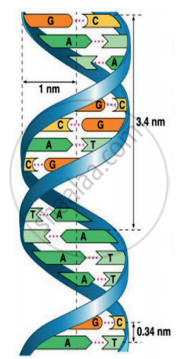
Structure of DNA
APPEARS IN
संबंधित प्रश्न
DNA strands are made up of phosphate groups, pentose sugar and four types of ______ bases.
State whether the following sentence is true or false:
The two DNA chains are parallel to each other.
Which of the following basic proteins DNA is associated?
Expand the abbreviation - DNA.
Erwin Chargaff's base equivalence rules established which of the following relationships in double-stranded DNA?
Which scientists produced X-ray diffraction images that revealed the helical structure of DNA during 1951–52?
In what year did Watson, Crick, and Wilkins receive the Nobel Prize in Physiology or Medicine for DNA research?
A nucleotide consists of three distinct components. Which of the following correctly identifies all three?
What is the approximate genome size of the human haploid genome?
