Advertisements
Advertisements
Question
How did Pi feel after drinking water?
Advertisements
Solution
After drinking water, he felt great. A sense of well-being quickly overcame him. His mouth became moist and soft. His skin relaxed. His joints moved with greater ease. His heart began to beat like a merry drum. Blood started flowing through his veins like cars from a wedding party honking their way through town. Strength and suppleness came back to his muscles. His head became clearer. In fact, he felt like returning from the world of the dead to life.
APPEARS IN
RELATED QUESTIONS
What is the importance of Aksionov’s wife’s dream?
Pick out the clues that convey that Makar Semyonich recognized Aksionov.
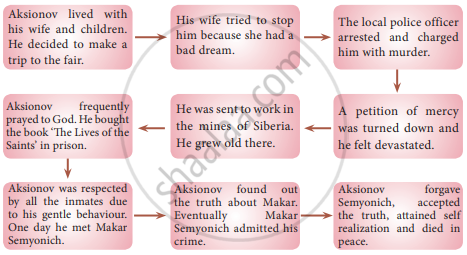
Using the mind map given below, write a brief summary of the story in your own words.
Who was Richard Parker?
Why was the great beast not behaving naturally?
Why did Pi want to tame Parker?
How did the presence of Richard Parker influence the attitude of Pi?
Why was John filled with shame?
How did Martha and John react when they came to know that Baldwin had rejected the generous offer made by Gresham?
Where did Max try to hide himself?
Who was Henry? Why had he visited Ausable’s room?
Who was Fowler? Why did he meet Ausable?
Sketch the character of Ausable.
Do you think physical appearance matters most for a secret agent? Answer giving reasons in the context of the story ‘The Midnight Visitor.
What makes the earth the one and only living planet?
Do you enjoy watching movies? What type of movies do you like to watch? Here are the pictures of a few blockbuster movies.
What do children get ready for at the beginning of the story?
What is the significance of the particular day described in the story “All summer in a day”?
Based on your understanding of the story, complete the story map.

Now read the sentence below. Complete them appropriately with the word you identified from the grid.
The children ______Margot as she ______the Sun.
Now read the sentence below. Complete them appropriately with the word you identified from the grid.
The children are _______ of Margot and ______the door and let her out.
Why was the speaker keen to know what day it was?
Mention the immediate steps taken by Lord Weston to protect himself from his assassin.
Do you think that Lady Weston did not care about the threat to her husband? State reasons.
How did Lord Weston ‘defuse’ the ‘infernal machine’?
What was the truth about the crumpled piece of paper?
Bring out the irony in the message “Remember Caesar”
Based on your understanding of the play, complete the Graphic Organiser (GO) suitably.