Advertisements
Advertisements
Question
How are the criteria for deciding divisions in plants different from the criteria for deciding the subgroups among animals?
Advertisements
Solution
Criteria for deciding divisions in plants are:-
(i) Differentiated/ Undifferentiated plant body
(ii) Presence/ absence of vascular tissues
(iii) With/without seeds
(iv) Naked seeds/ seeds inside fruits
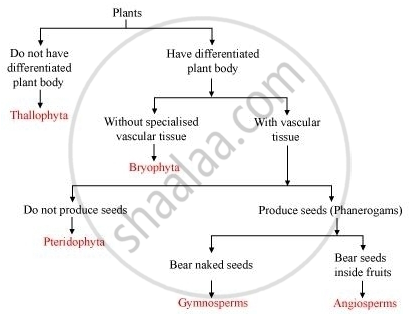
Criteria for deciding subgroups among animals are:-
Kingdom Animalia is divided into two major groups on the basis of the presence or absence of a notochord.
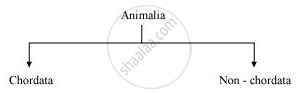
Non-chordates do not possess a notochord, while all members of the phylum chordates possess a notochord.
Non-chordate is further divided into subgroups on the basis of the following features:-
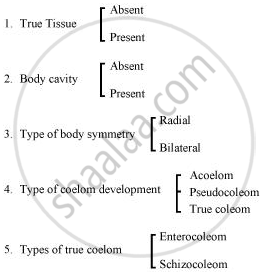
On the basis of the above features, non-chordates are divided into the following subgroups: Porifera, Coelenterate, Platyhelminthes, Nematodes, Annelids, Molluscs, Arthropoda, and Echinodermata.
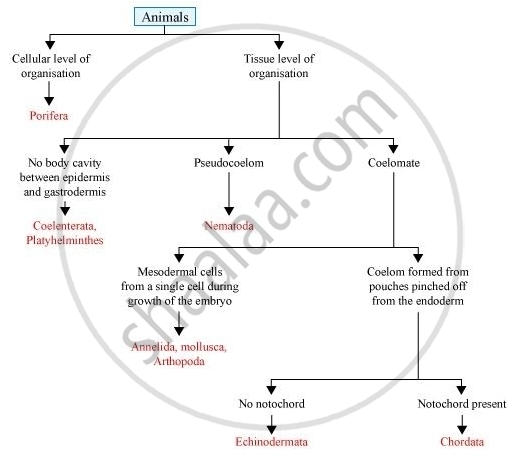
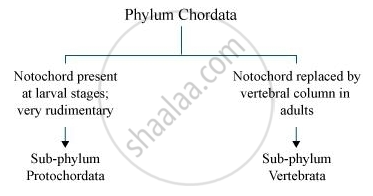
All members of the phylum chordate possess a notochord. However, some animals such as Balanoglossus, Amphioxus, Herdmania, etc. have a notochord, which is either absent or does not run the entire length of the animal’s body. Therefore, these animals are kept in a separate sub-phylum called Protochordata, and the rest of the chordates are included in the sub-phylum vertebrata. The members of the sub-phylum vertebrata are advanced chordates. They are divided into five classes: Pisces, Amphibian, Reptilia, Aves, and Mammalia.
RELATED QUESTIONS
Write down four main characters of Platyhelminthes.
Write down four main characters of Annelida.
What do you mean by the term coelomate animals?
What are adaptations in fishes due to which they are aquatic?
Write down four characters of Osteichtyes.es.
Distinguish between Nonchordata and Chordata.
Describe general characteristics of phylum Annelida.
Describe the important characters of mammals.
Rewrite the following scientific names correctly.
ficus religiosa (peepal), zea Mays (maize) and Bombyx Mori (silk moth).
What are the group names of the following categories of animals?
Animals with a backbone _____________
Give any one difference between the following :
Flatworm and Roundworm
Give four important characters of mammals.
Write name of any poikilothermic animal.
Write the name of oviparous mammal.
Fill in the blanks:
Nephridia are the excretory organs of ______.
Choose the correct answer: The animal of phylum mollusca is
True (or) False. If false write the correct answer.
True nucleus is seen in prokaryotic cell.
Assertion: Binomial name is the universal name and contains two names.
Reason: It was first introduced by Carolus Linnaeus
Kingdom Animalia is characterized by
