Advertisements
Advertisements
Question
Given below is the diagram of the human ear. Study the same and answer the questions that follow:

(i) Give the biological term for the part labeled ‘A’ and state its function.
(ii) Name the part labeled ‘B’ and state its function.
(iii) Name the part labeled ‘C’ and state its function.
(iv) Give the function of ear wax.
Advertisements
Solution
(i) Ear Ossicles (Malleus, incus, and stapes)—To receive, magnify and transmit the sound vibrations to the membrane of the oval window.
(ii) Eustachian tube—It equalizes the air pressure on either side of the eardrum allowing it to vibrate freely.
(iii) Auditory Nerve—It transmits the impulses from cochlea to the brain.
(iv) Ear wax-has insect repellent properties hence prevent the entry of insects in the auditory canal. It also checks to die entry of dust particles in the ear. Thus, it lubricates and protects the eardrum.
RELATED QUESTIONS
The unit of frequency is ______.
What is the function of ear ossicles?
The exact location of the Yellow spot
Where is the Utriculus located? Briefly mention its function.
The figure below is the sectional view of a part of the skull showing a sense organ:
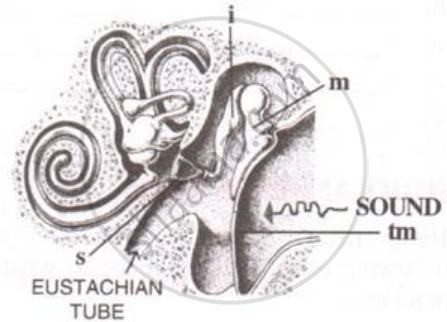
Name the part labeled 'tm'. What is its function?
Name the following:
The ear ossicle in contact with the oval window of the inner ear.
The Eardrum moves inward when a rarefaction reaches it.
Choose the odd one out from the following terms and name the category to which the others belong:
The median canal of cochlea is filled with ______.
Given below is the diagram of a part of the human ear. Study the same and answer the questions that follow:
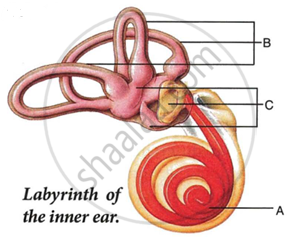 |
- Give the collective biological term for Malleus, locus and Stapes.
- Name the parts labelled A, B and C in the diagram.
- State the functions of the parts labelled 'A' and 'B'.
- Name the audio receptor region present in the part labelled 'A'.
