Advertisements
Advertisements
Question
Given below is the diagram of a part of the human ear. Study the same and answer the questions that follow:
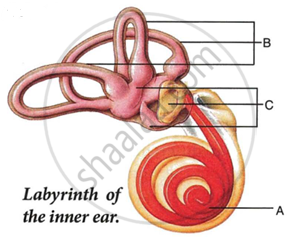 |
- Give the collective biological term for Malleus, locus and Stapes.
- Name the parts labelled A, B and C in the diagram.
- State the functions of the parts labelled 'A' and 'B'.
- Name the audio receptor region present in the part labelled 'A'.
Advertisements
Solution
- Ear ossicles
- A - Cochlea
B - Semicircular canals
C - Ear ossicles - The cochlea transmits impulses to the brain via the auditory nerve. Semicircular canals support the body's dynamic homeostasis.
- Organ of Corti, or spiral organ.
APPEARS IN
RELATED QUESTIONS
find odd one from following: Malleus, iris, Stapes, Incus.
Give biological explanations for We should not put sharp objects into our ears.
Differentiate between members of the following pair with reference to what is asked in bracket.
Dynamic balance and static balance (Definition)
State whether the following statements are true (T) or false (F). If false, correct them by changing any one single word in each.
Deafness is caused due to rupturing of the pinna.
Name that part of ear which vibrates when outside sound falls on it.
Give the main function of the following:
Cochlea
Choose the correct answer.
Canal joining middle ear to pharynx ___________
Given below is a diagram of a part of the human ear. Study the same and answer the question that follow:
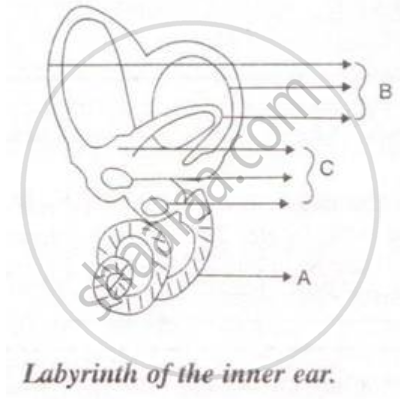
State the functions of the parts labeled 'A' and 'B'.
The part of the ear that turns pressure variations into electrical signals is ______.
Select the option with incorrect identification: