Advertisements
Advertisements
प्रश्न
Given below is the diagram of a part of the human ear. Study the same and answer the questions that follow:
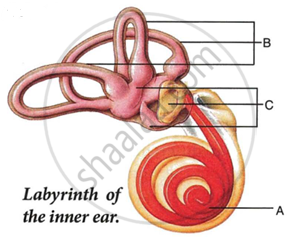 |
- Give the collective biological term for Malleus, locus and Stapes.
- Name the parts labelled A, B and C in the diagram.
- State the functions of the parts labelled 'A' and 'B'.
- Name the audio receptor region present in the part labelled 'A'.
Advertisements
उत्तर
- Ear ossicles
- A - Cochlea
B - Semicircular canals
C - Ear ossicles - The cochlea transmits impulses to the brain via the auditory nerve. Semicircular canals support the body's dynamic homeostasis.
- Organ of Corti, or spiral organ.
APPEARS IN
संबंधित प्रश्न
For human ears, the audible range is 20 Hz to 20,000 Hz.
Lightning and thunder take place in the sky at the same time and at the same distance from us. Lightning is seen earlier and thunder is heard later. Can you explain?
State the exact location of the Ciliary body
The three parts of human ear contributing in hearing are-
Where is the oval window located? Briefly mention its function.
The eardrum is known as ______.
The part of the inner ear which is responsible for hearing is ______.
Where are the following located?
Eustachian canal
With reference to human ear answer the question that follow:
Name the part of the ear associated with the amplification of vibrations.
- Draw a neat and well labelled diagram of the membranous labyrinth found in the inner ear.
- Based on the diagram drawn above in (i), give a suitable term for each of the following descriptions:
- The structure responsible for hearing.
- The sensory cells that help in hearing.
- The membrane-covered opening that connects the middle ear to inner ear.
- The nerves that carry impulses from the ear to the brain.
- The tube which equalises the air pressure on either side of the ear drum.
