Advertisements
Advertisements
Question
Given below are two stages in the evolution of man. Study them and answer the questions that follow:
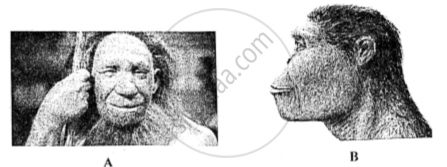
- Identify Australopithecus and Neanderthal man from the above pictures.
- Mention two characteristic features each for the two stages.
- Who proposed the theory of ‘Natural Selection’?
- Name the organism used as an example to explain ‘Industrial Melanism’.
- Give two examples of vestigial organs in humans.
Long Answer
Advertisements
Solution
(a)
A: Neanderthal man
B: Australopithecus
(b)
Neanderthal man:
- Had a large cranial capacity of about 1400–1600 cc
- Had a strong and robust body with a low forehead and prominent brow ridges.
Australopithecus:
- Had a small cranial capacity of about 450–600 cc.
- Had ape-like features, such as a projecting jaw and prominent brow ridges.
(c) Charles Darwin proposed the theory of Natural Selection.
(d) The peppered moth (Biston betularia) is used as an example to explain industrial melanism.
(e)
- Vermiform appendix
- Coccyx (tailbone)
shaalaa.com
Is there an error in this question or solution?
