Given below are two stages in the evolution of man. Study them and answer the questions that follow: (a) Identify Australopithecus and Neanderthal man from the above pictures.
Advertisements
प्रश्न
Given below are two stages in the evolution of man. Study them and answer the questions that follow:
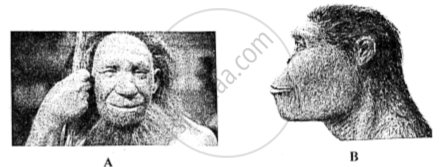
- Identify Australopithecus and Neanderthal man from the above pictures.
- Mention two characteristic features each for the two stages.
- Who proposed the theory of ‘Natural Selection’?
- Name the organism used as an example to explain ‘Industrial Melanism’.
- Give two examples of vestigial organs in humans.
Advertisements
उत्तर
(a)
A: Neanderthal man
B: Australopithecus
(b)
Neanderthal man:
- Had a large cranial capacity of about 1400–1600 cc
- Had a strong and robust body with a low forehead and prominent brow ridges.
Australopithecus:
- Had a small cranial capacity of about 450–600 cc.
- Had ape-like features, such as a projecting jaw and prominent brow ridges.
(c) Charles Darwin proposed the theory of Natural Selection.
(d) The peppered moth (Biston betularia) is used as an example to explain industrial melanism.
(e)
- Vermiform appendix
- Coccyx (tailbone)
APPEARS IN
संबंधित प्रश्न
Complete the following paragraph with the words given in brackets.
(Cro-Magnon, brain, fire, agriculture, Cultural, homo-sapiens, wise man)
Evolution of upright man continued in the direction of developing its ________ for the period of about 1 lakh years and meanwhile it discovered the __________. Brain of a 50 thousand year old man had been sufficiently evolved to the extent that it could be considered as a member of the class _______. Neanderthal man can be considered as the first example of _______. The _______ man evolved about 50 thousand years ago and afterwards, this evolution had been faster than the earlier. About 10 thousand years ago, wise-man started to practice the _______. It started to rear the cattle-herds and established the cities. _______ development took place.
All are major changes that took place in evolution of man, EXCEPT
Which amongst the following is the earliest fossil?
Who constructed flint tools?
Identify the CORRECT sequence of evolution of modem man.
Fill in the blanks (i - ii) and select the correct option.
- ______ probably ate meat.
- ______ buried dead bodies properly for the first time in pre-historic man's period.
Long tail, elongated tarsals, and binocular vision are seen in ______
Who among the Dryopithecus and Ramapithecus was more man-like?
What structural change to the spine accompanied bipedal locomotion in human evolution?
During which time period did Homo sapiens arise and spread across continents?
