Advertisements
Advertisements
Question
Given:
A = {Natural numbers less than 10}
B = {Letters of the word ‘PUPPET’}
C = {Squares of first four whole numbers}
D = {Odd numbers divisible by 2}.
Find: n(A ∪ D)
Advertisements
Solution
Here,
A= {1, 2, 3, 4, 5, 6, 7, 8, 9}
B = {P, U, E, T}
C = {0, 1, 4, 9}
D = { } or Φ
A ∪ D = {1, 2, 3, 4, 5, 6, 7, 8, 9}
n(A ∪ D) = 9
APPEARS IN
RELATED QUESTIONS
State, whether the pair of sets, given below, are equal sets or equivalent sets:
{5, 5, 2, 4} and {5, 4, 2, 2}
State, whether the pair of sets, given below, are equal sets or equivalent sets:
{2, 4, 6, 8, 10} and {a, b, d, e, m}
Given:
A = {Natural numbers less than 10}
B = {Letters of the word ‘PUPPET’}
C = {Squares of first four whole numbers}
D = {Odd numbers divisible by 2}.
Find: n(A)
If U = {x : x ∈ N, x ≤ 10}, A = {2, 3, 4, 8, 10} and B = {1, 2, 5, 8, 10}, then verify that n(A ∪ B) = n(A) + n(B) – n(A ∩ B)
In a class, all students take part in either music or drama or both. 25 students take part in music, 30 students take part in drama and 8 students take part in both music and drama. Find the total number of students in the class
A and B are two sets such that n(A – B) = 32 + x, n(B – A) = 5x and n(A ∩ B) = x. Illustrate the information by means of a Venn diagram. Given that n(A) = n(B). Calculate the value of x
In a colony, 275 families buy Tamil newspaper, 150 families buy English newspaper, 45 families buy Hindi newspaper, 125 families buy Tamil and English newspaper, 17 families buy English and Hindi newspapers, 5 families buy Tamil and Hindi newspaper and 3 families buy all the three newspaper. If each family buy atleast one of these newspaper then find Total number of families in the colony
In the adjacent diagram, if n(U) = 125, y is two times of x and z is 10 more than x, then find the value of x, y and z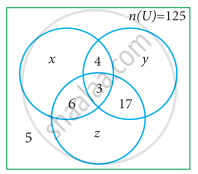
In a city, 40% people like only one fruit, 35% people like only two fruits, 20% people like all the three fruits. How many percentage of people do not like any one of the above three fruits?
Which symbol is used to denote the cardinality of a set A?
