Advertisements
Advertisements
Question
State true or false for the following. Correct the wrong statement.
If A = {0}, then n(A) = 0
Options
True
False
Advertisements
Solution
False
True statement is n (A) = 1
APPEARS IN
RELATED QUESTIONS
State, whether the pair of sets, given below, are equal sets or equivalent sets:
{2, 4, 6, 8, 10} and {a, b, d, e, m}
Write the cardinal number of the following set:
F = {Whole numbers from 8 to 14}
Given:
A = {Natural numbers less than 10}
B = {Letters of the word ‘PUPPET’}
C = {Squares of first four whole numbers}
D = {Odd numbers divisible by 2}.
Find: n(B ∪ D)
State true or false for the following. Correct the wrong statement.
If B = {1, 5, 51, 15, 5, 1}, then n(B) = 6.
If n(A) = 25, n(B) = 40, n(A ∪ B) = 50 and n(B’) = 25, find n(A ∩ B) and n(U).
In the adjacent diagram, if n(U) = 125, y is two times of x and z is 10 more than x, then find the value of x, y and z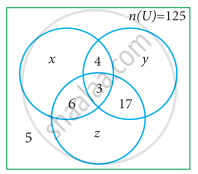
If n(A ∪ B ∪ C) = 100, n(A) = 4x, n(B) = 6x, n(C) = 5x, n(A ∩ B) = 20, n(B ∩ C) = 15, n(A ∩ C) = 25 and n(A ∩ B ∩ C) = 10, then the value of x is
If J = Set of three sided shapes, K = Set of shapes with two equal sides and L = Set of shapes with right angle, then J ∩ K ∩ L is
What does the "cardinality" of a set represent?
If Set A has the unique elements {2, 3, 5}, which of the following correctly represents its cardinality?
