Advertisements
Advertisements
Question
Give reason, why a matured mammalian erythrocyte lacks nucleus and mitochondria?
Advertisements
Solution
A matured mammalian erythrocyte lacks a nucleus and mitochondria. The lack of a nucleus
increases the surface area-volume ratio of RBCs, thus increasing the area for oxygen absorption.
Also, the lack of a nucleus reduces the size of the cell, making it easy to flow through the blood
vessels and more cells can be accommodated in a small area.
The lack of mitochondria implies that the cell does not use any oxygen absorbed for respiration,
thus increasing the efficiency of the cell to transport oxygen as all the oxygen absorbed is
transported without any loss.
RELATED QUESTIONS
what is Venule?
Given below is a highly schematic diagram of the human blood circulatory system.
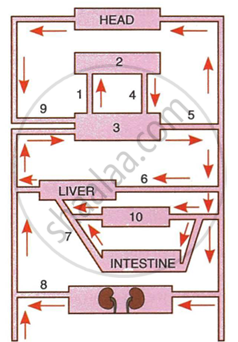 |
- Which part (state the number) represents the heart? Give reason in support of your answer.
- Which numbers represent the following, respectively?
Aorta Superior vena cava Hepatic portal vein Renal Vein Pulmonary artery Stomach
pH of oxygenated blood is ______.
Fill in the blanks with suitable words given below:
The liquid part of coagulated blood is known as ______.
In which organ of our body does blood get oxygenated?
Which side of the heart (left or right) contains oxygenated blood?
Multiple choice questions. Tick ( ✓ ) the correct choice:
The four blood groups in humans are
Fill in the blank:
The blood vessels which carry blood from the heart to different parts of the body are called ______.
Define the Veins.
Hematocrit is ______.
